“Preach the word: be instant in season, out of season: reprove, entreat, rebuke in all patience and doctrine.”
2 Timothy 4:2
It sure seems like mainstream Catholicism (a hybrid of ordinary folks and modernists) places a heavy emphasis on special events.
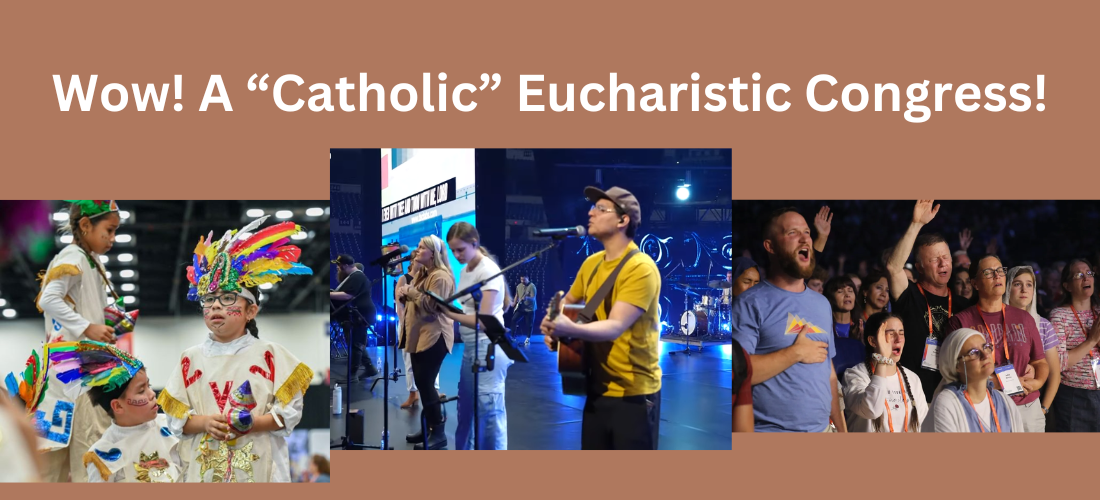
The Eucharistic Congress, currently underway in Indianapolis, seems reminiscent of World Youth Day, AKA another excuse to cram lots of young people into a crowded area. That aspect, all on its own, has a sterling track record in post-conciliar La-La Land. In today’s pseudo-church, we’re constantly entertained by some “major happening” or “speaking engagement,” always with the same controlled commentators or approved personalities.

I’ll keep this semi-analysis of the Eucharistic Congress short and sweet. All I have are a few congressional questions, which I invite readers to consider, and comment below (if you feel contributive).
Congressional Questions to Ponder . . .
- Do the modernists who host these events do so to address hemorrhaging church attendance, especially in the summer? Does this counter the fact that everyone practically jettisons Catholicism during this time of year (after Easter and before Christmas)?
- How much does this Eucharistic Congress feed into episcopal narcissism among those prelates who wish to appear as though they’re doing something? Many of these opportunistic prelates seem to enjoy anything that lends to a photo opportunity (despite overwhelming evidence they don’t believe in the Eucharist).
- Will the Congress-hosting bishops maintain a consistent offering of Eucharistic adoration a few months from now once the special event euphoria subsides? Let us recall how it was these very same “event bishops,” who had no problem pulling the plug on ALL Masses and adoration during the 2020 scamdemic lockdowns. We owe ourselves never to forget such unprecedented violences against the Catholic religion (especially since they’ve shown no shred of remorse over it).
- Finally, why must a Eucharistic Congress cost almost $30 million when Catholic clergy could offer their own processions and pious devotions locally? Could there be a profit motive buried somewhere within all this?
Salvation: The Long Game (not Special Events)
Those who seek eternal salvation, amid a lifetime of strenuous spiritual warfare, must focus on something more genuine than jolly events and the corresponding dopamine hits. The road to salvation, which is Calvary, is long and arduous, not some short-lived, effervescent experience.
Authentic Catholicism involves a day-in and day-out grind. What you observe among the modern event planners reminds me of lazy college students. Yes, imagine those who avoid profitable (but difficult) blue-collar careers in favor of the “easy mode” available with majoring in the liberal arts to net a white-collar job.
It’s all about taking shortcuts in one’s personal piety, and perhaps it should surprise nobody that young people always get lassoed into these public and ostentatious affairs.
“Does This Mean You Oppose Eucharistic Adoration Now???”
No, it’s quite the contrary. For one, we might fondly recall what Eucharistic Congresses were like when American Catholics . . . actually believed in Catholicism. You might notice many distinct elements of piety in the older gatherings, not well represented in the modern Indianapolis version.
At any rate, I don’t agree with others, who have dismissed the devotion altogether in light of the superficial approach of this Congress. Irrespective of how much modernists seek to butcher pious devotion, the traditional Church has held adoration in high esteem for many ages. See for yourself the exuberant testimony of the saints.
- “It is our duty to adore the Blessed Sacrament. No one receives the Blessed Sacrament unless he adores it…and not only do we not sin by adoring, we do sin by not adoring.” (St. Augustine)
- “Do you realize that Jesus is there in the Blessed Sacrament expressly for you, for you alone? He burns with the desire to come into your heart!” (St. Therese of Lisieux)
- “The daily adoration or visit to the Blessed Sacrament is the practice which is the fountainhead of all devotional works.” (St. Pope Pius X)
- “Eucharistic Adoration is the most necessary mission to the Church, which has even more need of prayerful souls than of powerful preachers or men of eloquence.” (St. Peter Julian Eymard)
- “Even a quarter of an hour’s prayer in front of the Eucharist perhaps gains more graces than all the other spiritual exercises of the day (outside of Mass).” (St. Alphonsus Ligouri)
Conclusion
That’s all I’ll have to say about this American Eucharistic Congress. I’m certainly not against Eucharistic adoration (far from it), but this reeks of yet another USCCB gimmick.
NB: Honesty compels me to admit, however, the Congress has not been without at least a few bright spots. That aside, I encourage people to form a deeper and more consistent appreciation of adoration; not relegating it to a seasonal theme or bishops’ agenda.
As always, pray the Rosary (15 decades) every day. If you have access, do it in front of the Blessed Sacrament in a quiet and reverent environment (be patient with the Boomers who cannot turn off their cell phones).
Bonus
For a deeper examination of this “special event” problem, consider this scathing documentary on the wicked Charismatic Catholicism. It’s long, and the author sounds like a 1958 Sedevacantist, but it’s informative, and explains much of the happy-happy, joy-joy nonsense you witness among today’s rather delusional Catholics.

 Catholics Aren't Zombies!
1 Comment