
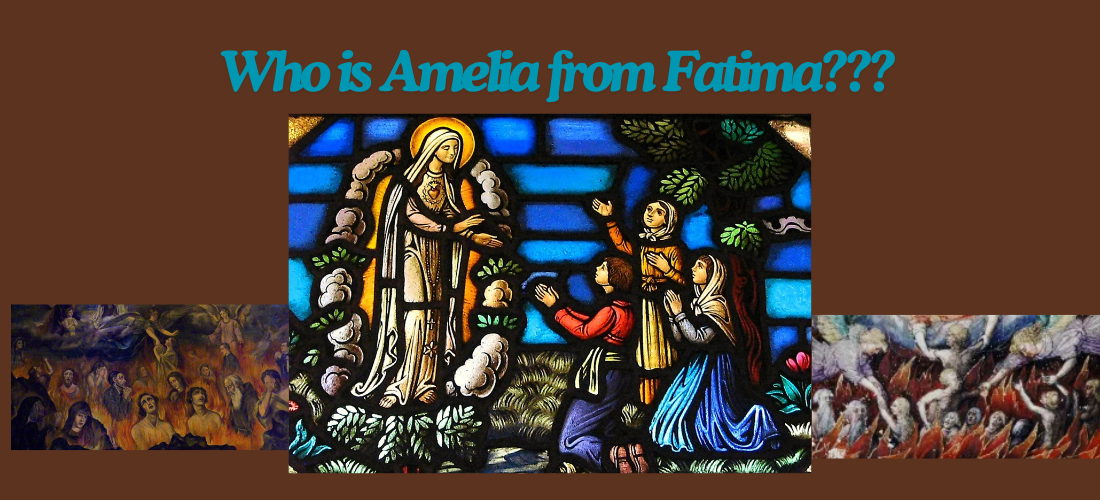
Then Lucia asked about Amelia, who had been between the ages of eighteen and twenty. Our Lady’s answer was startling: “She will be in purgatory until the end of the world.”
-Dialogue between Sister Lucia and Our Lady of Fatima (1917)
Consider how profound it is to know of a specific individual who would languish in Purgatory until the consummation of the world. That’s quite a crushing expiatory sentence at even just a cursory glance. However, there’s more to its profundity.
Amelia from Fatima is quite possibly the lone person we know for sure is (and will remain) in Purgatory. We know souls go there, but cannot often identify particular ones for sure. Plus, other souls may not stay there for an indefinite duration, like Amelia, meaning we don’t know if the deceased relatives for whom we pray still require such prayers.
Amelia, to the contrary, most urgently needs them, which will not change until the world ends.
Then again, who else do we know would remain there with the guarantee of the Blessed Virgin? This should, of course, elicit empathy for the poor young lady’s imprisoned soul.
Although our knowledge of Amelia (or anyone else) residing in Purgatory comes from private visions, the Fatima apparitions are among the most approved and reliable. I suggest we reflect on why we’ve been given the knowledge of this young woman’s lingering fate in that fiery quadrant of Hell.
Many Important Reasons to Pray for Amelia from Fatima
One can’t help but feel sorry for someone who will have to endure Purgatory until the end of the world, which may or may not be right around the corner. Beyond that, why should we pray for some distant person, who died over 100 years ago, from faraway Portugal (NB: with kind regards to my 12 Portuguese readers this year)?
Mercy for ANY poor soul in Purgatory is a worthy starting place. These are folks who have secured their joyous home in heaven, the place of eternal bliss with God Almighty. Yet they must wait in the most painful domain, aside from the demon-infested, God-forsaken Inferno.
This Affects Us Too, Though . . .
Also, for our sake, if there’s a connection between the end of the world, and Amelia achieving the beatific vision, we ought to take notice. The end of the world, and the coming of Christ, should strike us with excited anticipation. Our praying for Amelia could hasten the end of this evil turmoil, as we inch closer to the showdown with the Antichrist, and suffer Satan’s final and most furious assaults.
In other words, let us wish for it to end sooner rather than later.
Finally, we ought to take notice of the severity of Amelia’s sentence, despite dying at such a young age. What could have led poor Amelia to earn the wages of such a long stay in Purgatory?
Sources say she may have sinned against purity with a brother-in-law, and although she died a holy death, with the sacraments of the Church, still had to expiate those offenses. Let this be a reminder of the purpose of praying for the dead, each other, and begging God for the grace of perseverance every single day. It’s an essential lesson for just how serious spiritual warfare is in the first place.
The eternal stakes are enormous, most Catholics reach neither heaven nor Purgatory, and nobody can enter the former with any slight stain of sin on their souls.
Never Overlook The Enormity of the Purgation Pains
It’s almost overwhelming to meditate on the incredible pains of Purgatory. In this life, there are many agonizing experiences, enough to bring us to our knees all on their own. Purgatory is worse than the summation of all those pains.
You could suffer staph infection while passing a gallstone, during an episode of vertigo, together with an incredible migraine, while strapped to a burning grill after receiving a vicious scourging. All of that combined would pale in comparison to the slightest afflictions in Purgatory. Our human understanding of the topic doesn’t anywhere near approach what it means to suffer true pain.
Apparitional Accounts of the Misery of Purgatory
Would you like to learn more about the magnitude of this suffering?
Then I welcome you to read this comprehensive resource from America Needs Fatima. It includes an astonishing apparition, where a deceased father visits his daughter (from Purgatory) and addresses several of her questions regarding it.
“Is it true that the sufferings of Purgatory are much greater than all the torments of earth and even of the martyrs?”
“Yes, my daughter, all this is very true.”
Sister Serafina then asked if everyone who belongs to the Scapular Confraternity of Carmel (those who wear the scapular), is freed from Purgatory on the first Saturday after death:
“Yes,” he answered, “but only if they are faithful to the Confraternity’s obligations.”
“Is it true that some souls must stay in Purgatory for as long as five hundred years?”
“Yes. Some are condemned until the end of the world. These souls are very guilty and entirely abandoned.”
If this is a plausible testimony, then we’d better pay closer attention to the fulfillment of those Confraternity obligations. Fr. Nicholas Gruner helpfully explains them here:
Theology of Purgatory
St. Thomas Aquinas, the Church’s most eminent theologian, for his part, had this to say about the greatest sufferings in Purgatory.
“. . . there will be a twofold pain; one will be the pain of loss, namely the delay of the divine vision, and the pain of sense, namely punishment by corporeal fire. With regard to both the least pain of Purgatory surpasses the greatest pain of this life.”
Disregard Naysayers Who Would Downplay Purgatory
“Purgatory will be fine for me when I die.”
Please let me know how that works for you. Others have also held this mis-guided view, only to experience a most rude awakening.
It’s one thing to say that you would prefer Purgatory to this world because you would gain certainty of your salvation (no longer any chance of offending God; forfeiting salvation). It’s quite another to assume your experience of it would be anything less than incredible agony, the likes of which you’ve never even fractionally perceived.
Are there any ways to comprehend the miseries those suffering souls endure? No, because they are unfathomable, but I have some imaginative suggestions, which may assist.
Consider the “Campfire” Meditation
Since it’s difficult to understand the torturous, expiating heat of Purgatory, I suggest we work with our limited faculties and formulate an educated guess (albeit an incredibly weak one).
The next time you enjoy a warm campfire, take a few moments to inch a little closer to it. You don’t have to fall into the flames, but sit as close as you can. Make sure it’s a potent fire, not something you’re struggling to kindle.
Then feel the immense heat of the flame. Meditate on how you probably couldn’t endure even just a little higher temperature without perishing, passing out, inhaling too much noxious smoke, or simply writhing in agony.
Now, remind yourself how that scorching campfire, intense as it may be, is an utterly combustible joke compared to the fires of Purgatory (and the Fiery Inferno). Furthermore, there are souls, who walked this Earth like you and I, who exist endlessly surrounded by it without relief, experiencing worse than any severe burn victim ever has.
Purgatory is neither for the faint of spirit nor a runner-up holding pattern for folks who didn’t arrive in heaven immediately. It’s part of Hell, minus the tormenting demons and limitless regret of forever losing God’s friendship. Let us take it a little more seriously than the typical negligence found among modern Catholics (if they believe in it at all).

Amelia’s Purgatory Plight: A Crucial Reminder to Pray the Rosary
You’re already aware of a few reasons we should pray the Rosary, as requested by Mary (at Fatima and various other apparitions). It carries us on a meditative journey through Jesus’ early life, passion, death, and resurrection, before concluding with the glories of the Holy Spirit and Mary. Given all that, taken along with the holy prose of its prayers, one cannot pray the Rosary, for any length of time, and persist in mortal sin.
However, this time of year, it gets even better for true Marian devotees.
In less than two weeks, we will celebrate the Feast of Our Lady’s Assumption, one of the Church’s highest commemorations, and a splendid opportunity for liberating souls from Purgatory. According to multiple Church Doctors, like St. Peter Damian, this is the feast where more souls leave Purgatory to enjoy the beatific vision than any other occasion.
Traditional piety holds that upon the Blessed Virgin’s Assumption into heaven, all of Purgatory emptied of those long-awaiting souls who joined her in Paradise (per her request). That being said, what better way to expedite more souls into heaven, in honor of Her Assumption, then by following her request to pray the Rosary for that selfless intention?
What else can we do to help poor souls with the Rosary?
It’s also most merciful to pray one’s Rosary in a cemetery for those who toil sorrowfully in Purgatory. You can do this anytime of year, not solely on All Souls Day, as some are wont to believe. Therefore, all Catholics should develop a steadfast devotion to praying for the poor souls in Purgatory, including Amelia from Fatima.

 Catholics Aren't Zombies!
2 Comments