I have understood more than all my teachers: because thy testimonies are my meditation
–Psalm 118:99
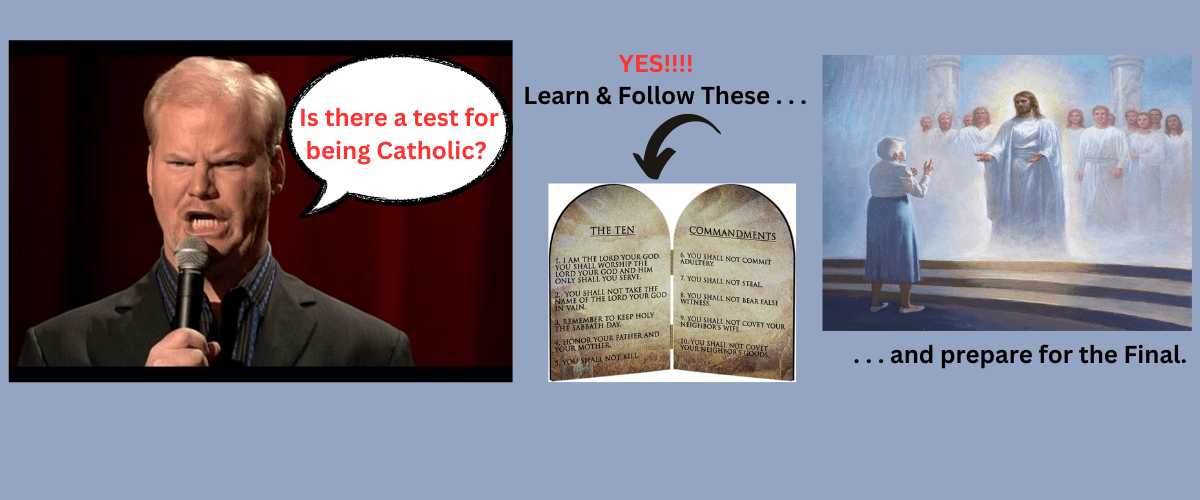
I’m amazed at how many Catholics would utter asinine comments, like this one from Catholic comedian, Jim Gaffigan:
“I’m not a good Catholic. If there was a test for Catholics, I would fail. But then again, most Catholics would fail, which is probably why there’s not a test.”
Now, to some extent, I can appreciate Gaffigan’s humility (he may even be one of the better comedians). Nevertheless, remarks like these always lead me to conclude that Catholics cannot be bothered to investigate the fine details of the religion they profess.
Also, I contend that there is an exam, of sorts, for assessing one’s mastery of Catholicism. Unfortunately, many Catholics would fail, both for not knowing the answers, and for their unwillingness to fulfill their corresponding obligations.
Let’s check out the exam . . .
Catholic Exam → The 10 Commandments
The 10 Commandments are not test questions, per se (they’re imperatives rather than interrogatives). However, we can expect a test on how well we understand and implement their contents (our particular judgment). Despite their significance, how many Catholics could recite even half of the Commandments, let alone remember them in their proper order?
Well, see for yourself, and determine whether you know them by heart.
- “I, the Lord, am your God. You shall not have other gods besides me”
- “You shall not take the name of the Lord, your God, in vain”
- “Remember to keep holy the Lord’s day”
- “Honor your father and your mother”
- “You shall not kill”
- “You shall not commit adultery”
- “You shall not steal”
- “You shall not bear false witness against your neighbor”
- “You shall not covet your neighbor’s wife”
- “You shall not covet your neighbor’s goods”
Of course, the Catholic exam isn’t a mere memorization exercise. You must grasp more of their context and have an awareness of the deadly ways to violate them (mortal sins against each one).
What does it mean, for example, to “not kill”? Does it include self-harm or spiritual murder (scandalizing others)? There are many components worthy of reflection. Yet, most Catholics do not seem to think this way; they don’t delve very far into the specific implications of the Commandments, usually owing to excessive worldly obligations.
We sinners offend God by breaking His Commandments in almost limitless ways.
- Greed
- Lying
- Gossiping
- Trading one’s soul for “muh salary and benefits”
- Obedience to false authority figures
- Failure to raise one’s children
- Skipping Mass for superfluous reasons
- Lusting over all the women around us
- Wearing the tightest clothing possible (a woman problem, primarily)
- Making little or no effort to avoid near occasions of sin
- Negligence toward prayer and/or examination of conscience
- Failure to read Holy Scripture or spiritual books
- Seldom confessing one’s sins
- . . . and countless others.
So, suffice to say, we FAIL the proverbial Catholic test because we ignore ALL the Commandments with our obliviousness or apathy toward grave sin.
10 Commandments → Two Great Commandments
Next, consider how those 10 Commandments coalesce into the Two Great Commandments from Our Lord. The first three correspond with loving God with all of one’s heart. Then the latter seven call for us to love our neighbors as ourselves (given in both Leviticus and the Gospel).
Fr. Dave Nix has commented on how even the original Commandment tablets (in Exodus) featured three commandments on one with the other seven on the other. This signified the distinction between the Two Great Commandments (explained later by Jesus in the Gospel). It was one of several ways God bridged the Old and New Testaments, and reinforced the critical importance of following all of His Commandments (not just ones we like, either).
Would Anyone Pass a Test of the 10 Commandments?
Perhaps not many would pass.
If the Two Great Commandments require us to know (and honor) ALL of God’s 10 Commandments, what does this mean for most contemporary Catholics?
Well, we must say, with great lamentation, that Mr. Gaffigan’s comments were correct: most Catholics would fail the test, to the tremendous detriment of their souls. A failure to learn and live by the 10 Commandments leaves me with little doubt over why so few souls ever enter heaven. According to a consensus among the saints, this has always been true, but for various reasons, the saved:damned ratio is especially lopsided nowadays.
Our particular judgments, after all, are not flimsy tests, resembling a social promotion to 1st grade. To the contrary, if you do not learn how God wants you to love Him, then you are doomed to Hell for all eternity.
“That’s not very encouraging! I thought your website doesn’t involve discouragement.” *points at website tagine*
Yes, but it would be impossible for anyone to encourage those who obstinately refuse to attempt to obey God’s laws. God Himself has no choice but to withdraw His grace from hardened sinners who choose to hate Him (their entire lives) by defying his mandates. Therefore, most Catholics (and non-Catholics, too) fail the test miserably.

Need an Exam Study Guide or Further Reading?
Then, for further exploration, one would benefit tremendously from reading from some of the many wonderful Church catechisms.
Those are the detailed documents designed to delineate scripture and tradition (the two core components of Catholicism). There are several catechisms, some simpler or more complex than others, but each very helpful for learning the significance of prayer, the sacraments, faith & morals, and beyond. Simply put, they’re like a guidebook or user’s manual for understanding the Catholic religion.
Here are a few examples of reliable catechisms (so, excluding the suspect, and not infallible CCC from 1992).
- Catechism of the Council of Trent → very thorough coverage of the Creed, the seven sacraments, the 10 Commandments, and the Lord’s Prayer
- Baltimore Catechism → question/answer format; covers every tenet of the Creed, the 10 Commandments, and several prayers
- Catechism of Pius X → very thorough coverage of the Creed, several prayers, the sacraments, 10 Commandments, Church precepts, theological virtues, and more; Fr. Dave Nix has terrific tutorials on this catechism
Did you notice how each mentions the 10 Commandments? It’s almost as if Holy Mother Church wants us to know a few things about them. Who would have thought?

Is There a Final Exam for Catholicism?
As I’ve already alluded to, there is indeed a “final” exam (for the course called “life”), otherwise known as your particular judgment, but it’s more like the grading process. Once your life has finished, you cannot revise your answers to the test, and the Just Judge, Jesus Christ, will evaluate you on whether you learned and obeyed His commandments.
Once you arrive at your particular judgment, you cannot change test answers (i.e., your lifelong habits and behaviors) because the exam period will have ended. You can, however, prepare for judgment (if you begin now) not by “cramming” for anything, but by living a good life, which requires all men to learn the Catholic religion. Sts. Francis de Sales, Alphonsus Liguori, and other holy figures dub this the science of the saints.
Oh, but how few saintly scientists exist, for everywhere you go in the world, seldom will you encounter those who comprehend basic Catholic principles.
This results from possessing no knowledge of the catechisms and scripture as well as a dearth of training on what it means to live an upright life. Below is an inexhaustive list of habits and behaviors, conducive to such a lifestyle, albeit widely ignored by modern Catholics.
- Daily prayer for at least an hour (even lay people)
- 15 minutes of spiritual reading (including, but not limited to, the bible)
- Basic comprehension and practice of the 64 virtues
- Daily examination of conscience (referencing the 10 Commandments and/or Seven Deadly Sins)
- Regular confession (monthly or even just bi-monthly)
- Weekly Eucharistic adoration
- Fasting from meat on Fridays (all year)
- . . . and so forth.
Conclusion: Pray Psalm 118 for the Grace to Obey God’s Commandments
My lips shall utter a hymn, when thou shalt teach me thy justifications.
-Psalm 118:171
Besides the 10 Commandments, God generously offers many ways to meditate on the fruits of following His holy mandates. Many of the psalms attest to this, but you’ll find this holy theme most prominently within the longest of the Psalter: Psalm 118 (using the traditional numbering). Until recently, this was what all clergy and religious would pray almost every day.
You may hear Psalm 118 referred to as the Rosary of the Psalter, owing to its repetitiousness.
It consists of 176 verses, often extolling God, invoking repeated promises to love, honor, and obey His justifications, testimonies, mandates, and commandments (many words, all essentially testifying the same thing). This is a stark contrast from the modern devotion to moral relativism and self-determinism; opposing the complete dependence and devotion to God’s law.
As I’ve written in other places, the collapse in orthodox vocations to the priesthood may have much to do with less commitment to the Breviary and this important psalm. Both lay people and clergy should strive to reverse this problem, given the abundant lawlessness, chaos, and lack of charity found throughout society.
Then, if anyone’s curious, the exhortation to love God’s commandments emerges in several other psalms of the Psalter as well. Here’s one other example (among many).
Blessed is the man that feareth the Lord: he shall delight exceedingly in his commandments.
–Psalm 111:1
Finally, here are two devotions you might consider for rejuvenating your love of God’s commandments.
- Pray the Holy Rosary of the Blessed Virgin Mary (all 15 decades; especially the 4th Joyous Mystery, the Presentation of Jesus, emphasizing obedience to God’s law)
- Recite Psalm 118 every Sunday, beginning at Prime as it appears in the 1960 Roman Breviary (or any other traditional version)
I hope this helps, and yes, you will receive a grade (pass/fail) . . . by the Just Judge, to whom you cannot lie, or offer excuses for your negligence.
In the meantime, enjoy this 100% unrelated and irrelevant meme . . .
Bonus Meme!


 Catholics Aren't Zombies!