
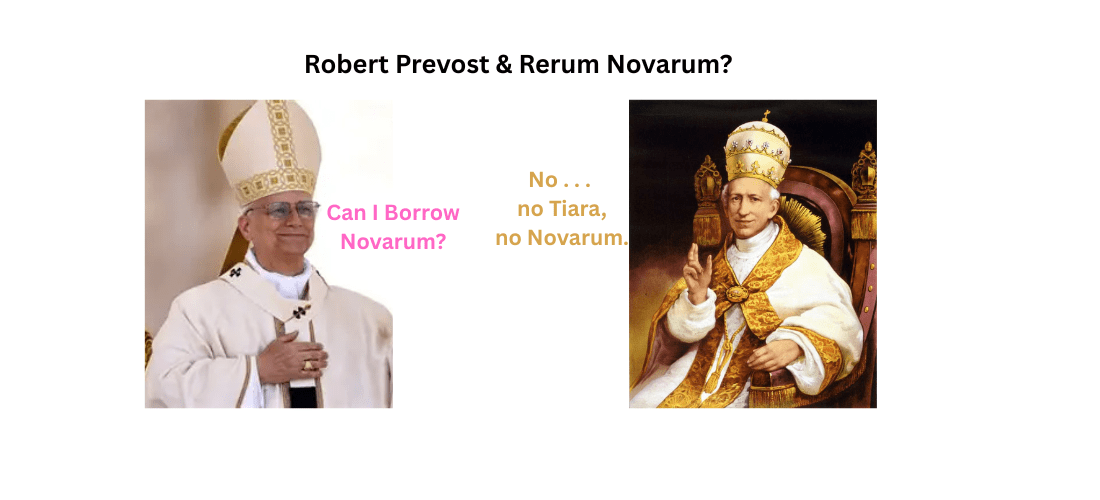
“It is no easy matter to define the relative rights and mutual duties of the rich and of the poor, of capital and of labor. And the danger lies in this, that crafty agitators are intent on making use of these differences of opinion to pervert men’s judgments and to stir up the people to revolt.” –Rerum Novarum (Pope Leo XIII, 1891)
Some believe Robert Prevost selected the name “Leo XIV” out of an interest in furthering “Catholic Social Justice,” supposedly introduced by Pope Leo XIII, of happy memory. This pertains specifically to his encyclical, Rerum Novarum (15 May 1891), devoted to new matters affecting the condition of the working classes.
I shall explain, however, that Robert Prevost’s intentions cannot be genuine, given that his ideas depart radically from those of that encyclical (and almost the entirety of Catholicism). The structure of this article, a summary of Pope Leo XIII’s 14,000-word encyclical, divides it into seven sections, accompanied by my anticipation of Prevost’s backwards interpretations.
I created section names based on my reading of Rerum Novarum (these are not the encyclical’s subheadings).
- On Revolutionary Spirits
- Prevost’s take
- Private Property Ownership & So-Called “Alienation”
- Prevost’s take
- Property: Man, Family, & The Right to Inheritance
- Prevost . . .
- The Nature of Labor & Organic Class Structures
- Prevost . . .
- The Role of the State in Providing Relief
- Prevost . . .
- Working Conditions, Working on Sunday, & Both Sexes in the Workplace
- Prevost . . .
- Just Wages
- Prevost . . .
On Revolutionary Spirits
The encyclical begins by stating that “the spirit of revolutionary” has crossed from the sphere of politics over into “practical economics,” which the pope considers not surprising.
This same spirit, having devastated Christian monarchies for decades prior, wiggled into economics, forcing the pope to address it, over 40 years after Marx’s Communist Manifesto. Like anything else that opposes a Catholic organic society, Pope Leo rightfully called it evil, referring to socialists as “crafty agitators,” who “stir up the people to revolt.”
He asserts the socialists were up to no good from the start, albeit in less forceful terms than his predecessor, Pope Pius IX. Therefore, let us dispense with the notion that Leo XIII’s writings offer some ridiculous proof that “Jesus was a socialist.” This is patently absurd at face value.
Instead, Leo criticizes the socialists, who capitalize on the poor’s envy of the rich, and propose solutions, always involving the elimination of private property. The Holy Pontiff concludes that the workman would be the first to suffer in a system of total state ownership of property.
He also devotes multiple paragraphs to workers’ oppression following the abolition of the workers’ guilds (replaced by nothing else to support them) in the previous century. This was the miserable fate Catholics faced, thanks in no small part to the disruptive French Revolutionaries and other successful hellraisers all across Europe.
Prevost on This Topic?
So, in the light of a woeful socio-economic landscape, which has worsened considerably, would the current “pontiff” suggest rebuilding the trade guilds or would he side with the socialist revolutionaries?
It seems quite clear that he aligns himself with “Liberation Theologists,” the false religionists, whose theology comes straight from the KGB. Rumor has it, these folks walk on crucifixes and would prefer “social justice” to salvation. Peru, where Prevost spent much of his priestly career, was home to the so-called “father” of Liberation Theology, Fr. Gustavo Gutierrez. It’s hard to imagine they never crossed paths, of course.
While Leo XIII lamented how the “public institutions and the laws set aside the ancient religion,” this “Leo XIV” trips over himself to ingratiate false religions. Prevost never emphasizes the true Catholic religion, as a legitimate pope would, but continues the Bergoglian lie that “all religions lead to God.” If those 19th century revolutionaries were alive today, they would congratulate Robert Prevost as a favored great-grandson to their movement.
Private Property Ownership & So-Called “Alienation”
Pope Leo XIII continues his refutation of socialism, claiming that 100% property ownership clearly distorts the functions of the state.
“. . . he therefore expressly intends to acquire a right full and real, not only to the remuneration, but also to the disposal of such remuneration, just as he pleases.”
I believe this contradicts all the Marxist gibberish over “alienation.” That’s the theory, which claims employers exploit their workers primarily by forcing them to detach themselves from the goods they produce.
This ignores basic common sense, however.
Of course a laborer would alienate himself from his remunerative labor. That’s the whole point. Why bother to make shoes or harvest corn if all you ever did was keep everything? Non-subsistence farming implies that you part ways with whatever you produce, by exchanging it for currency or capital.
Pope Leo further develops this stance, asserting:
“There is no need to bring in the State. Man precedes the State, and possesses, prior to the formation of any State, the right of providing for the substance of his body.” He continues with, “Those who do not possess the soil contribute their labor; hence, it may truly be said that all human subsistence is derived either from labor on one’s own land, or from some toil, some calling, which is paid for either in the produce of the land itself, or in that which is exchanged for what the land brings forth. ”
Socialists never seem to comprehend that part about exchange. That’s because they are ignorant, intrinsically belligerent, disagreeable, and altogether anti-social.
Prevost on This Topic?
So, the real Leo XIII clearly wouldn’t advocate the confiscation and redistribution of private property or a ridiculous welfare state (as we’ll see in the next section). His “successor Leo,” Mr. Prevost, cherishes a different point of view:
“God gives everyone the same thing, because everyone deserves to feel appreciated.”
At least that was the spirit of his message, amid his intention to drag the Catholic Church down to the level of the United Nations. As Chris Jackson explains, it’s a “soft gospel” of mediocrity, where everyone receives the same wage, irrespective of effort, and the only mortal sin is that of inequality. This is clearly not the consistent message of the Catholic magisterium; not prior to its hijacking by Bergoglio, Prevost, and several other Vatican II villains.
Property: Man, Family, & The Right to Inheritance
What about property and the flourishing of Catholic families?
The right to private property, derived from God’s Commandments, becomes ever more important when man becomes “fruitful and multiplies,” thereby expanding his family. Such expansion and nourishment is impossible without private property. Try, as the socialists might, to destroy the concept, they accomplish nothing but the opposite of prosperity.
This we can verify by examining the American embrace of communism, juxtaposed with its radical birth-rate decline and the rise of the Culture of Death. Communism, with its vicious abhorrence of private property, always kills families.
Rerum Novarum also endorses man’s right to transmit his productive property to his children through inheritance. It also makes consistent mention of the authority of a FATHER as head of a family. Nowadays, typical welfare-driven families have no father figure whatsoever, save for the state. This perverts the God-given design for families to flourish through a patriarchal hierarchy.
“The contention, then, that the civil government should at its option intrude into and exercise intimate control over the family and the household is a great and pernicious error.” (Rerum Novarum, Section 14)
The state should only come to the aid of distressed families, not dictate to them. However, as we notice the word “aid,” we might wonder if that somehow connotes a welfare state? No, because public authority only ever intervenes to prevent a “grave disturbance of mutual rights” among family members.
This is, however, not carte blanche for statist tyranny since “rulers of the commonwealth must go no further; here, nature bids them stop.”
Nature forbids the state to overstep its boundaries (as enforcer or protector) and wander into the odious laboratories of social engineering. Suffice to say, there should be no welfare state or any other mechanism to cultivate welfare queens at the cost of organic families. We should also remember the far superior ways to address problems, especially among faithful Catholics.
If economic injustices occur, according to Leo XIII, “no practical solution of this question will be found apart from the intervention of religion and of the Church.”
So, what happens when these jolly purveyors of “social justice” aren’t really Catholic and do not believe in God? It’s a fast recipe for disaster. As Pope Leo III contends, “. . . all the striving of men will be vain if they leave out the Church.” That brings us, yet again, to what we might expect from our Peruvian friend from Chicago.
Prevost on This Topic?
Indeed, there are many diverse attacks on families and their private property. This includes the manifold ways the socialist state taxes us into impoverishment.
Although Leo XIII only briefly mentions it in Rerum Novarum, we have a decent reason to believe he would have heard of the nefarious inheritance taxes. Even in just the United States, we’ve had some semblance of this socialist confiscation since the Civil War.
This and many other issues may lead us to inquire whether Prevost believes we should follow his predecessor’s advice and eliminate every dreadful “death tax”? I doubt it since it would put him at odds with his tax-happy brethren. I also doubt the most ecumenical man on the planet (right now) would want to impose Catholicism on distressed families. That might ruin his entire program for inter-faith dialogue.
The Nature of Labor & Organic Class Structures
While we may view “back-breaking labor” solely as a punishment meted out to Adam and his progeny, there’s much more to it than that. Even before the fall in the Garden, man was created for activity. This distinction escapes the minds of a great number of people, nowadays.
“As regards bodily labor, even had man never fallen from the state of innocence, he would not have remained wholly idle; but that which would then have been his free choice and his delight became afterwards compulsory, and the painful expiation for his disobedience.”
So, that dispels one misunderstanding about labor, but there are others. “Class conflict” is a myth as well. The pope explains how different classes are complimentary, like various regions of the body. They cannot survive separately and all require oxygenated blood to last any length of time. Likewise, in the socio-economic context, religion is the glue that holds rich and poor together.
This obviously carries certain moral responsibilities and obligations for all parties: workers, managers, and owners alike. Workers mustn’t mutiny against their employers, nor should employers view workers as “things in the pursuit of gain.” Pope Leo also reminds us that defrauding a worker of a just wage carries the same moral condemnation as sodomy, harming widows/orphans, and murder.
Revolutionary leftists understand only fragments of that last part. They would decry the defrauding of a worker, but gladly partake in sodomy, murder, and the creation of a welfare state that produces de facto widows and orphans ceaselessly.
Pope Leo concludes his thoughts with a few words about “distribution.”
“True, no one is commanded to distribute to others that which is required for his own needs and those of his household; nor even to give away what is reasonably required to keep up becomingly his condition in life, ‘for no one ought to live other than becomingly.’ But, when what necessity demands has been supplied, and one’s standing fairly taken thought for, it becomes a duty to give to the indigent out of what remains over. “Of that which remaineth, give alms.”
This refers to a voluntary giving of alms, not confiscation and redistribution at the hands of some strong man. Such a nuance eludes almost every “Catholic socialist” you’d ever encounter. Pope Leo also explains that the giving of talents pertains to both material wealth and “gifts of the mind.” Therefore, if you lack alms to give, then you can just as soon perform other acts of mercy, and still help the lowliest, for the glory of Christ.
Prevost on This Topic?
If authentic magisterium, transmitted through Rerum Novarum, tells us that class conflict is a myth, then most of Prevost’s career in Peru becomes irrelevant at best. Class conflict is about all Liberation Theologists do. Otherwise, from what else is there to liberate the poor?
If one’s poverty wasn’t the result of cruel masters, and just an unfortunate accident or unavoidable reality, then one would only need aid, not any release from imprisonment. Surely, dear reader, you can see the difference between liberate and aid, along with the differences between Prevost and Leo XIII. From this, we must conclude that Prevost’s ideology does not consider that classes could coexist for mutual advantage, or that ONE religion can agglutinate them together.
The Role of the State in Providing Relief
Section 31 of Rerum Novarum addresses the purpose of the state in offering relief for workers met with misfortune.
According to Pope Leo XIII, the state should ensure laws that benefit the commonwealth (the common good), enabling every class to thrive. I might add that this need not involve a zero-sum game (as the dastardly socialists attest), forcing the vibrancy of those classes into constant odds with one another.
Since man’s primary aim is to grow in virtue, the state’s objective should be to ensure justice, affording man a better chance of achieving his purpose. Material matters do, however, contribute to this. Because a commonwealth prospers by virtue of the workingman’s labor, it is essential for state administrators to watch over them and ensure their opportunity to flourish.
Here, the pope speaks of the state’s role of protecting the safety of the commonwealth. It’s a far cry from so-called “nanny states” or “semi-socialist republics.” He offers various examples of when the state might intervene:
“If by a strike of workers or concerted interruption of work, there should be imminent danger of disturbance to the public peace; or if circumstances were such as that among the working class the ties of family life were relaxed; if religion were found to suffer through the workers not having time and opportunity afforded them to practice its duties; if in workshops and factories there were danger to morals through the mixing of the sexes or from other harmful occasions of evil; or if employers laid burdens upon their workmen which were unjust, or degraded them with conditions repugnant to their dignity as human beings; finally, if health were endangered by excessive labor, or by work unsuited to sex or age – in such cases, there can be no question but that, within certain limits, it would be right to invoke the aid and authority of the law.”
I’ll explore these concepts further in the next section, but, first, let us briefly consider the opposite of Leo XIII’s take on distributive justice and the workmen’s dignity.
Prevost on This Topic?
Nothing from Rerum Novarum corresponds with Bergoglio-Prevostian-style redistribution. Most of the encyclical speaks consistently contrary to the warped, modern Liberation Theology. The state is more of an enforcer of contracts, securing the general rule of law, quelling riotous uprisings, and other basic protective police/military functions.
Furthermore, everyone understood this aptly enough before the “Enlightenment,” communism, and other brainwashing, intellectual novelties. The state doesn’t regulate as much as it protects and enforces.
All of that changed once evildoers (Jewish Freemasons, worst of all) subjected everyone to stifling regulations, like the “Pure Food and Drug Act,” income taxation, banking regulation, and so forth. All of those horrifying innovations came 15 to 20 years after this encyclical, enacted by wicked tyrants who were anything but Catholic.
Far from being a socialist or even semi-socialist document, Rerum Novarum almost sounds libertarian in many sections (though not anarcho-capitalist). You could easily fit this entire encyclical into the framework of a Nozickian “Night Watchman State” of minimal governance. Today’s Catholics, including self-professed traditionalists, erroneously believe that Church teaching requires the existence of massive bureaucracies, else justice cannot exist (this is wildly incorrect).
Working Conditions, Working on Sunday, & Both Sexes in the Workplace
Next, there are several other angles regarding the qualitative difficulty of man’s wage-earning work in modern society. Some of it is physically demanding, dangerous, exhausting, and, if excessive, enough to distract him from his spiritual and familial obligations. There are also many times where dedicated and honest workers fall victim to nefarious thieves who would find innumerable ways to exploit or rob them.
Pope Leo XIII addresses these concerns, first, by acknowledging that the state must protect individual rights, with a particular emphasis on the poorest and hardest workers. He justifies this as follows:
“. . . neither justice nor the common good allows any individual to seize upon that which belongs to another, or, under the futile and shallow pretext of equality, to lay violent hands on other people’s possessions.”
Next, writing in 1891, he emphasizes the supreme importance of workers resting on Sunday, per God’s commandment. The reader might recall the severity of this problem in places, like France, starting in the 18th/19th centuries. St. Jean Vianney railed against Sunday labor in his preaching, whereas the Blessed Virgin warned the French of this sin’s gravity through multiple apparitions (including at La Salette and elsewhere).
Either way you slice it, both employee and employer play a role in halting the horrible practice of putting one’s servile work ahead of God’s commandments. Pope Leo XIII suggests this much in his encyclical as well.
Then, he warns of the dangers of men and women working together in factory/workshop environments, demanding safeguards and precautions from employers. It is far better for men and women, who possess different talents, to work in separated and specific gender roles for several reasons. This includes avoiding the workplace drama and rampant marital infidelity, of which we’ve become all too familiar, in recent times.
He finishes the topic by addressing the physicality of the hardest-working laborers (like coal miners) who should receive adequate time to rest and recuperate. I can attest to the negligence of this matter myself, having spent almost 10 years managing in factory environments. For all the blustering about “workers’ rights,” among the socialists, they’ve held dominant control of industry for decades, permitting workmen’s welfare to plummet worse than ever.
The communists now hold no better than two solutions: 1) eliminate workers through obsolescence, and/or, 2) radical depopulation of the “surplus population.” We should never have trusted these rotten bastards, neither in Pope Leo’s time, nor at any point since.
Prevost on This Topic?
When was the last time Prevost, Bergoglio, or the rest of the Liberation shysters chastised anyone (rich or poor) for violating the Third Commandment? They never do because they are “irreligionists,” evident by their aversion to the authentic Catholic religion, and adherence to Vatican II universalism.
So, while these men feign concern for the proletariat, they do nothing at all to halt them from imperiling their souls by shackling themselves to an addiction to work. Many Americans and others throughout the world cannot halt themselves from several hours of work almost every Sunday. Yet, the Vatican hierarchy (whom we’re supposed to believe is legitimate) utter nothing contrary to this sinful behavior.
So much for workers’ welfare.
Moreover, would Prevost ever confront the modern ill-practice of men and women working in close confines? I think most certainly not, and this despite so many harmful consequences.

Just Wages
Rerum Novarum discusses the often controversial concept of just wages, beginning in Section 41.
According to the Pontiff, man earns his wages, keeping in mind two important considerations. These include: 1) an agreement with the employer on what he is to earn, and 2) his very survival.
The latter is far more essential than the former, but you wouldn’t know that from listening to today’s Jewish greedy business owners. Here, the encyclical might offer a slightly “social justice” tone to the typical American ear, but this would have been little more than common sense in ages past.
I would say the idea of “accept whatever wage you get” is more in line with the loathsome “Protestant Work Ethic,” which has long-infected Western Civilization. In a nutshell, it’s the Protestant mentality of treating work itself like a sacrament (for those folks who reject God’s real Church and Sacraments).
This line of reasoning tends to ignore how economics was much more entrepreneurial back in the old days when not every man had an “employer.” The suffocating problem of “wage slavery” only exists because the socialists (with the help of Protestants) have configured everyone into employer/employee relationships since the Industrial Revolution. Neither the Catholic Church nor secular Christendom created or insisted upon the employer/employee distinction, which has degenerated into miserable dyadic relationships between “all-knowing owners” versus (typically) hapless employees.
Classical economics would consider both sides as negotiating equals, two sides of a mutual contract. I don’t believe a Catholic economist (since Catholics practically invented classical economics) would argue otherwise.
The pope goes on to say that we cannot assume it is only the negotiation aspect that merits significance, as if wages were just a matter of rigid contractual agreement. Men of good will are bound, by the moral law, to survive, as commanded by God (to be fruitful), Who we cannot disobey.
Furthermore, employers would be unjust to manipulate their workers into disobeying their survival needs (which depend on sufficient wages) by threatening the loss of employment, lest they accept less compensation. In other words, employers should not behave like “typical Jews,” like Ebeneezer Scrooge, and scare their employees to death for requesting a day off on Christmas. There are many other similar examples of this wicked dynamic, not at all limited to Dickensian literature.

Then, Pope Leo returns to the subject of state intervention.
“The right to possess private property is derived from nature, not from man; and the State has the right to control its use in the interests of the public good alone, but by no means to absorb it altogether. The State would therefore be unjust and cruel if under the name of taxation it were to deprive the private owner of more than is fair.”
So, once again, the state may play a role in enforcing contracts (as courts of law often do). However, this is a far cry from today’s corrupt system of confiscation via “corporate property taxes” and other economy-torturing measures. The pope reiterates his support for workers’ guilds or unions for quelling contract disputes between workers and employers, reducing the necessity for state interference.
Rerum Novarum justifies the value of guilds and associations as an important support mechanism by alluding to Holy Scripture. Woe to him that is alone, as it says in Ecclesiastes. Workers’ guilds (which are not the evil government unions of the United States) serve to support laborers and enhance bargaining leverage.
This does not mean such guilds enjoy complete impunity, though. Sometimes, it may be necessary for the state to intervene if such guilds, associations, and societies devolve into illegal activities. This might draw to mind the villainous deeds of those most notorious societies, such as the Freemasons.
Finally, there are Catholic confraternities and religious orders, which the state should not impede, but be willing to defend if necessary. Religious groups offer an important counter to evil organizations. Pope Leo XIII seems to acknowledge the latter problem (Freemasonry) when he says:
“Now, there is a good deal of evidence in favor of the opinion that many of these societies are in the hands of secret leaders, and are managed on principles ill – according with Christianity and the public well-being; and that they do their utmost to get within their grasp the whole field of labor, and force working men either to join them or to starve.”
The pope also mentions how individual Catholics can help the plight of struggling workers through the establishment of insurance societies. This might bring to mind groups, such as the Knights of Columbus (founded during Leo’s pontificate, in 1882). Unfortunately, although the Knights’ mission began admirably, as a financial assistance outfit, they, too, became self-interested, greedy, and Jew-day-ized.
What is the “bottom line” message underpinning this encyclical?
It is that all societies, state protection, and so forth, must be conducive to the flourishing of religion and morality. If any of them (let alone, all of them) trade religion for material gain, then they become like that pitiful man who conquered the world, only to lose his soul.
Prevost on This Topic?
Perhaps I’m not the first to report that today’s employers view paying their workers as a means to an end; never the end itself.
That’s because they answer only to a profit motive rather than a motive of mutual benefit (Jew-ism, yet again). Therefore, we shall see no end to the “AI interruption” in the marketplace anytime soon. Even the “kindest” employers make the profit motive the alpha and omega of all business operations.
While there’s nothing wrong with replacing some human labor with machines (for miserable tasks that ruin the body), today’s elimination of labor has little to do with efficiency and productivity. It’s a response to a hyper-regulated economy, where labor costs a fortune, combined with unprecedented Jewish greed among increasingly Jewish owners.
What does Prevost have to do with any of this?
Well, we should wonder whether he’ll have anything Catholic to say regarding AI, hyper economic regulation, sovereign nations printing money to ruin their economies, etc.? I strongly suspect he won’t, and until then, it won’t matter how much a worker earns, after watching the value of his currency disintegrate, before losing his livelihood to robots.
It’s difficult to imagine Prevost will help “liberate” us from these hardships, since it’s his UN buddies and other communists who perpetrate and enhance them in the first place.
Conclusion
While I hope you enjoyed this analysis of worker conditions, according to Rerum Novarum, let us not neglect the other apocalyptic developments of Leo XIII’s Pontificate. It was during his reign that we obtained a special insight into the tribulations that await us. It was the same Holy Pontiff who experienced the vision of the devil confronting Our Lord, and securing a chance to inflict untold pain upon humanity for 100 years.
Working conditions are important, but pale in comparison to the fate of our eternal souls, especially if Our Lord’s Second Coming is right around the corner.
As such, we should say often the prayer composed by Pope Leo himself, beseeching St. Michael to defend us in battle against the wickedness and snares of that same devil. You can pray it at the end of every 15-decade Rosary, asking for Our Lady’s intercession during our dire times. Our Lady, St. Michael, and the entire Heavenly Court wishes to aid us during these unprecedented years of intense spiritual warfare.

 Catholics Aren't Zombies!
1 Comment