
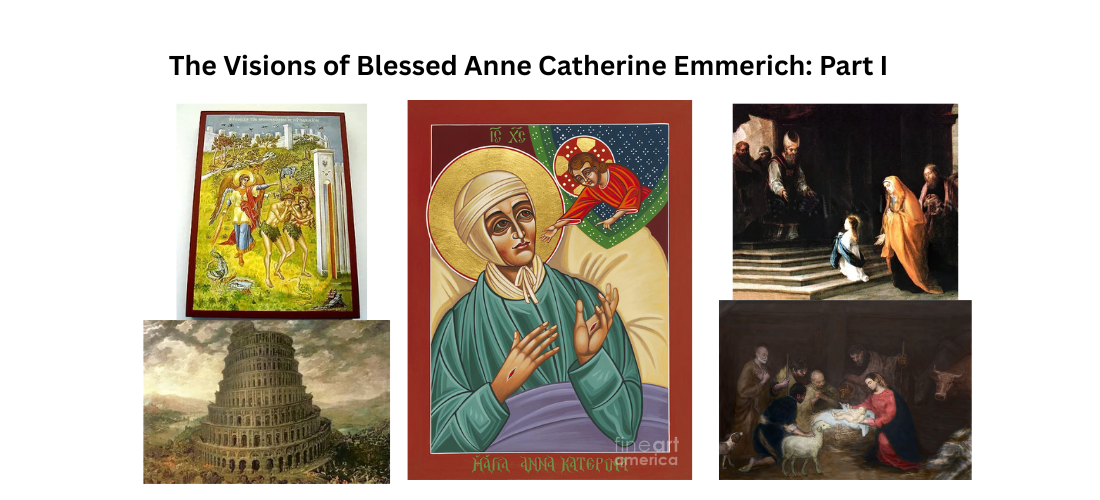
“Owing to the spirit of the world and tepidity, if the Savior returned to earth today to announce His doctrine in person, He would find as many opponents as He did among the Jews.” – Blessed Anne Catherine Emmerich
The many visions received by the German nun, Anne Catherine Emmerich, deserve at least a passing glance from devout Catholics.
Emmerich, who lived in the 19th century, experienced vivid accounts of biblical history, along with prophetic seeings of future eschatological events. She mystically witnessed the lives of Old Testament figures (Abraham, Job, Joseph, etc.), Jesus’ Incarnate Life, and the forthcoming apostasy throughout the Catholic Church. Given their breadth and profundity, I’d like to explore the themes and revelations found in Blessed Anne’s visions.
Since the entire catalog of visions is so extensive, I will break my review into smaller sections. This edition will cover the first two volumes, devoted to what she saw regarding the Old Testament through the birth of Jesus Christ. My analysis won’t recall every detail (which would be impossible to do succinctly), but will instead analyze the topics and descriptions I found most edifying.
Important Caveat Lector: I would be remiss if I failed to acknowledge the relative controversy involving the transcription of Blessed Anne’s visions, which has led some to reject them wholesale. The reader should approach any visionary narrative with an understanding that no apparitional seer can claim infallible accuracy or freedom from clumsy misinterpretations of what they witness. Also, in Blessed Anne’s case, skeptics often discount the accuracy of her visions, transcribed by a lay poet by the name of Clemens Maria Brentano. I permit the reader to investigate and judge for themselves whether Mr. Brentano fabricated or embellished any of Blessed Anne’s visionary accounts. Nevertheless, I recommend noticing how the opponents of Blessed Anne and Mr. Brentano appear to be Jews the same dishonest enemies we encounter in so many other arenas.
Without further ado, let’s explore the fascinating revelations received by Blessed Anne Catherine Emmerich.
Old Testament Visions
The multi-volume anthology of Emmerich’s visions begins, of course, with all the magnificent elements of God’s creation, some 6,000 years ago. She briefly conveys all she witnessed of God’s creation: Adam & Eve, the animals, and all the surrounding environment (in its initial glory).
This was a time of perfect harmony before the fall, when even the fiercest animals were still gentle, noble, and amiable toward our first ancestors. Speaking of Adam, Blessed Anne writes,
“He wondered at nothing, nor was he astonished at his own existence. He went around among the trees and the animals, as if he were used to them all, like a man inspecting his fields.” She continues to note, “In the middle of his heart, I saw a sparkling halo of glory. In it was a tiny figure as if holding something in its hand. I think it symbolized the Third Person of the Godhead.”
Alas, Christians know that man’s once magnificent dignity, as it was in that primitive paradise, would suffer the sorrowful strike of Original Sin. Blessed Anne describes the entire process by which Eve became fixated with a particular bipedal “serpent” and succumbed to its trickery. I found it interesting that her description mentions a walking and upright animal, contradicting the typical illustrations of a slithering snake tempting Eve.
This makes perfect sense since it was not until God administered His punishments that the creature would have to roam the Earth on its belly. Her narrative shows how Eve, even before reaching for the apple, spent an inordinate time chasing after this singular animal in particular.
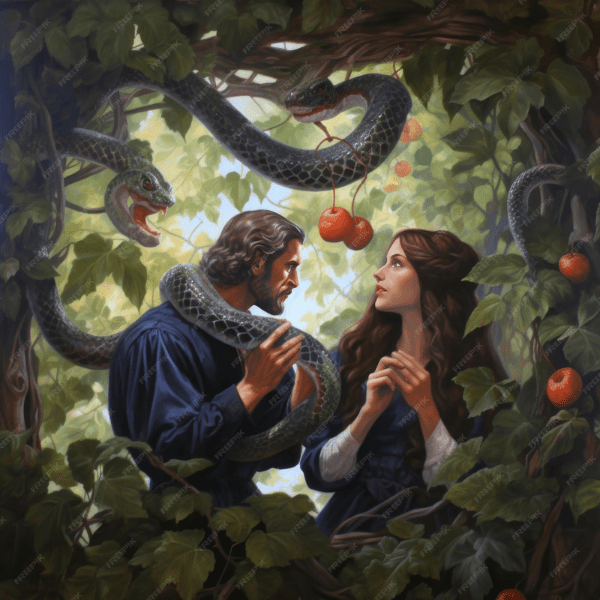
This, of course, established a setting for the rest of salvation history. Her visions include an extensive emphasis on the ancient enmity between the seed of the woman and seed of the serpent.
Following original sin, God repossessed something from Adam’s right side, the same place from which He created Eve. This was essentially the perfect grace all subsequent humans would enjoy were it not for sin. Later, we would discover God’s reinstatement of this grace through the Immaculate Conception of the Blessed Virgin. In the meantime, Adam and Eve had to adapt to a much more degraded world as the resplendent nature cascaded into a much less hospitable shell of its former glory.
By this point, man would suffer death, learn to tame the land, and reproduce in a less ideal way than God’s original design.
Next, if you read the entire account of the Genesis events, you would notice a heavy emphasis on the preservation of relics. This is the consequence of our mortality, and the apparent need to keep a salvific continuity all the way from Adam to the redemption period. Blessed Anne puts it this way:
“I once had a vision of Mount Calvary. I saw on it a prophet, the companion of Elias. The mount was at that time full of caves and sepulchers. The prophet entered one of the caves and from a stone coffin filled with bones he took up the skull of Adam. Instantly an angel appeared before him, saying: ‘That is Adam’s skull,’ and he forbade its removal. Scattered over the skull was some thin yellow hair. From the prophet’s account of what had occurred, the spot was named ‘The Place of Skulls’ (Calvary).”
So, if what she discovered about Calvary was true, then it would indeed be essential to safeguard Adam’s remains, amid the Deluge, the Egyptian Exodus, and other biblical episodes. Emmerich also offers similar insights into other sacred items, including the Holy Grail, which was created early in Genesis and preserved all the way to Our Lord’s Last Supper.
Therefore, when His time to suffer had come, Our Savior did not select just any random cup for His institution of the Holy Eucharist. Neither did He choose to shed His Blood from the Cross onto just any location.
What did Emmerich make of the great Deluge?
Her narrative corresponds to what we vaguely know about the wickedness that provoked it. Our ancestors fell even further than Adam and Eve, permitting the demons to sway them into an array of occult practices, everything from cosmetics and witchcraft to idol worship.
This, and all the interbreeding between humans, giants, and other forbidden mates, led God to punish most of humanity except Noah and a few others. It took the holy patriarch hundreds of years to finish the Ark that would save them because of his off-and-on construction efforts. Many of his hirelings ridiculed Noah’s designs, only to suffer their drowning deaths once God commenced the flood.
Blessed Anne also mentions that many more children and adults were aboard the Ark than the families specifically cited in Genesis. There were multitudes of animals aboard the vessel, but God required Noah to rescue at least one of each species to sustain them during the ordeal.
Eventually, Blessed Anne’s Genesis description turns to the building of the Tower of Babel, an endeavor replete with idolatry, gnosticism, and other barbaric paganism. After the Deluge and the Curse of Ham, the Tower represented a resurgence of paganism and superstition. She identifies key biblical/historical villains, such as Nemrod, Derketo, and Semiramis, all of whom devoted themselves to occult practices.
The tower builders not only practiced extensive spell-casting and sacrificing but also cared very little if any workers fell to their deaths from it. The same could not be said if any of the precious building materials plummeted off their abominable tower. Indeed, its architects possessed the same feverish fixation with its construction as modern oligarchs have for building AI data centers everywhere.
The narrative continues with the stories of Abraham and Job, who were contemporaries and holy figures. Blessed Anne explains how Job’s sufferings came in waves several years apart from one another. This does not contradict the scriptural account, but runs counterintuitive to a basic reading of it. It reminds us that Job’s chastisements happened over at least a course of 30 years altogether.
Neither Abraham nor Job was a big fan of pagan Egypt, arguably the most corrupt civilization in history. Emmerich’s explanation of the Egyptians’ dishonest historicity may have contributed to today’s misguided understanding of the duration of ancient history.
“I saw too that once they reckoned nine hundred and seventy days to a year, and again, years were computed as months. I saw a pagan priest drawing up a chronological table in which for every five hundred years, eleven hundred were set down.”
Have you not noticed, dear reader, that all of today’s archaeology seems to depend on these erroneous chronologies? Why else do secularists presume to believe that the world is at least hundreds of thousands of years old, granting limitless credence to flimsy ancient Egyptian record keeping?
At any rate, the ancient Egyptian hegemony was something both Abraham and Job had to endure. Thankfully, as the scriptures attest, both enjoyed the pastoral guidance of the eminently holy figure, Melchisedech. Blessed Anne details this tremendous figure as an angel, and Old Testament forerunner of Christ.
Melchisedech commanded the respect of all those he encountered, including the wicked idolaters, like Semiramis. Recall, of course, that even St. Paul refers to him as a “priest of the Most High God” and he who blessed Abraham.
“I have seen Melchisedech appearing here and there, interposing and legislating the affairs of nations; as, for instance, at the celebration of victories after war, at that time waged with such cruelty. Wherever he appeared, wherever he was, he exercised an irresistible influence by his mere pres-ence. No one opposed him, and yet he never resorted to harsh measures; even the idolaters cheerfully accepted his decisions and acted upon his advice.”
Although much of the remainder of Genesis seems bleak (what with the Deluge, Sodom and Gomorrah, and so forth), there are some surprising glimmers of hope. Even some of Genesis’ antagonists may have achieved salvation, according to Emmerich. Not every sinner receives automatic damnation for their crimes, as we might presume after reading the scriptures.
Figures like Caan, Potiphar’s wife, and some of those who succumbed to the Deluge may have repented and regained God’s grace. Caan in particular, received his infamous curse, and had to endure the contempt of his family, but may still have died in God’s friendship.
Blessed Anne’s visions also contain many other hopeful themes despite the ancient civilization’s rapid deterioration. The descriptions of the patriarchs (Abraham, Isaac, Jacob, etc.) focus heavily on sustaining hope for the coming “Promise,” or Messiah. This holy hope would endure for a few thousand years, at least among the remnant faithful, preceding the Incarnation of Our Lord.
That concludes the most notable Old Testament visions. I did not mention every rich detail, but this should encourage readers to investigate her Old Testament revelations further.
Next, we should explore the revelations pertaining to the early lives of Jesus, Mary, and Joseph before and during the New Testament scriptures. These span from the adulthood of St. Anne and St. Joachim all the way through the hidden life of Jesus Christ.
Early New Testament Visions
Mary’s Family – Good Jews
In today’s world, few are willing to consider the distinction between “good” and “bad” Jews. There is such a difference, evident by the state of the Hebrew nation prior to Christ’s earthly ministry.
During the early Church, and directly preceding it, there existed four Jewish camps: 1) Essenes, 2) Pharisees, 3) Sadducees, and 4) Zealots. Jewish unity was therefore quite fractured, much like Christianity in today’s collapsed Western Civilization. One can find little cooperation among the various factions. The diagram below introduces an easy way to comprehend these 1st-century Jewish groups.
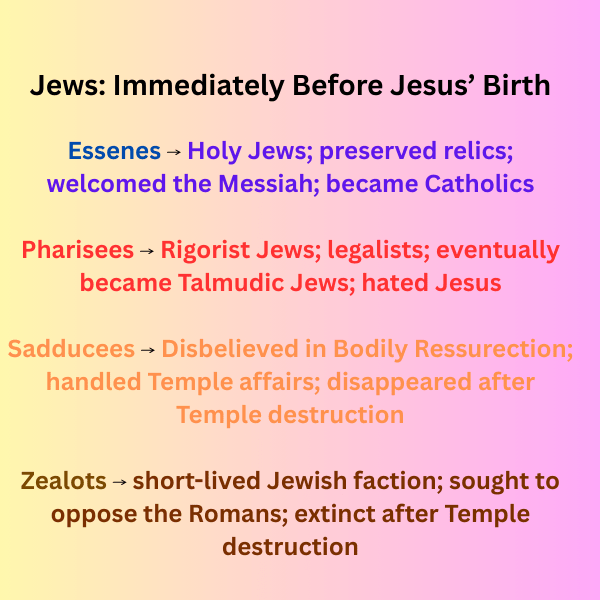
St. Anne, the mother of Mary and grandmother of Jesus, was among the Essenes, as was St. Joachim, her spouse, and several other holy individuals from the New Testament. This group generally despised the company of the other Jews. Blessed Anne’s visions showed how many of St. Anne’s extended family piously sought to become suitable candidates as mother of the coming Messiah. This included the Salome family, St. Elizabeth’s parents, and several others.
Why does this matter? Who cares about these so-called Jewish camps?
It is because there was, even during pre-Messianic times, a manifestation of the ancient enmity between those Jews who oppose God versus those few who love Him. Just as Esau opposed Jacob, and Joseph’s brothers sought his death, so did the Pharisees and Sadducees antagonize the more faithful Jews of the late-Old-Testament period.
Moreover, this dynamic continues to be inescapable, regardless of the time period. The good Jews, the Essenes, like traditional Catholics today, faced almost constant ostracization from the legalistic, self-absorbed, ostentatious, arrogant Pharisees. The Essenes took the abuse and marginalization from the Caiaphas/Herod crowd, whereas today’s true Christians suffer limitless persecution from the Netanyahus and Prevosts of the world.
This was the state of the world at the time of Mary’s Immaculate Conception. Only St. Anne, St. Joachim, and a few others occupied the faithful Essene remnant.
The Immaculate Conception, Mary’s Birth, & Early Life
The Immaculate Conception is one of several events of which Blessed Anne was privileged to envision. Here, we find something so pivotal to the Catholic religion: God’s way of beginning His correction of what mankind lost through Original Sin. Our heretical friends, the wayward Eastern Heterodox, have no framework for understanding Mary’s spectacular creation, insofar as they reject that dogma.
Mary’s Immaculate Conception was how all members of humanity would have been born were it not for the fall in the garden. It involved that supernatural essence, which God retrieved from Adam directly after his sin. This is how Emmerich witnessed it mystically in her visions:
“I saw the soul of Mary, formed by the Most Holy Trinity, in movement. I saw the Divine Persons interpenetrating one another. It became a great shining mountain, and still like the figure of a man. I saw something from the midst of the Three Divine Persons rising toward the mouth and issuing from it like a beam of light. This beam hovered before the face of God and assumed a human shape, or rather it was formed to such. As it took the human form, I saw it, as if by the command of God, most beautifully fashioned. I saw God showing the beauty of this soul to the angels, and from it they experienced unspeakable joy.”
Any Marian devotee should already know that Her Immaculate Conception was followed by Her joyous birth, service in the Temple, and eventual espousal to St. Joseph. Blessed Anne fills in several wonderful details, of which I will relay just a few, hoping you would read the visions yourself.
She notes that Mary’s birth was a great joy for all, including for the fathers in Limbo. Her nativity forced every demon to self-exorcise out of all possessed men. Yes, as Mary entered the world, similar to the birth of Jesus, much of the almost boundless evil seemed to subdue itself promptly.
During that blessed September day, there were multiple reports of idols falling from pagan temples and cast into the sea. Even Holy Simeon saw from the Temple several demoniacs shouting, “We must withdraw, we must go out,” once the Woman who would crush them was born.
Mary would live a most upright, holy, and obedient childhood, before becoming the Mother of God. She was said to be the most willing to rise multiple hours in the night for prayer or perform any task given by her superiors in the Temple. Mary would also beseech God for the opportunity to serve whomever would become the mother of the Messiah. She did not presume such dignity would fall to her, but eagerly awaited His arrival.
“I often saw the child Mary seized with holy longing for the Messiah and saying to Anna: ‘Oh, will the promised Child be born soon? Oh, if I could only see that Child! Oh, if only I am living when He is born!’ Then Anna would give this reply: ‘Think how old I am and how long I have waited for that Child! And you—you are still so young!’ And Mary would shed tears of longing for the promised Saviour.”
The story of Mary’s childhood is accompanied by a terrific narration of St. Joseph’s life before their marriage. Blessed Anne’s visions, for instance, explain why we see St. Joseph holding a lily in many of his holy images. Once it became clear Mary and her other virgin companions could no longer remain in the Temple, the Essene families arranged for various suitors to vie for her espousal.
Each suitor received a branch, which they were to hold during the sacrifices. Whichever suitor held the branch that blossomed would obtain the right to wed the Blessed Virgin Mary. As it came to pass, St. Joseph’s branch was the only one to blossom, which it did, into a lily-like white flower. The rest was history, leading to his and Mary’s most chaste marriage, the Annunciation of the Lord, and the Visitation with St. Elizabeth.
Below is how Emmerich describes the Annunciation:
“As Mary uttered the words: ‘May it be done unto me according to thy word!’ I saw an apparition of the Holy Ghost. The countenance was human and the whole apparition environed by dazzling splendor, as if surrounded by wings. From the breast and hands, I saw issuing three streams of light. They penetrated the right side of the Blessed Virgin and united into one under her heart. At that instant Mary became perfectly transparent and luminous. It was as if opacity disappeared like darkness before that flood of light.”
Notice again how the streams of light entered Mary’s right side, signifying the return of what was lost from Adam’s right side (namely, salvation). This prefigures the piercing of Jesus’ right side, which would emit the dual flow of His Precious Blood and baptismal water, from His Sacred Heart, for the salvation of mankind.
The Visitation
As scripture informs us, the Blessed Virgin immediately proceeded to visit her cousin, Elizabeth, before the birth of St. John the Baptist. The visionary description does not embellish the Visitation much at all beyond what we encounter in St. Luke’s account of the Gospel.
“Mary and Elizabeth entered the room in which was the fireplace. Here they embraced, clasping each other in their arms and pressing cheek to cheek. I saw light streaming down between them. Then it was that Elizabeth, becoming interiorly inflamed, stepped back with uplifted hands, and exclaimed, ‘Blessed art thou among women, and blessed is the Fruit of thy womb.”
This was followed by the rest of the Gospel dialogue between the two, then by Our Lady’s first recitation of her Magnificat. During the visit, Emmerich confirms that both Mary and Elizabeth were silent about the Annunciation. St. Joseph did not yet know, although he accompanied Mary faithfully on their journey to Hebron.
Throughout her stay, Mary and Elizabeth prayed the splendid Magnificat several times each day, signifying the holiness of the gorgeous canticle. St. Joseph and Mary remained with their relatives for a celebratory feast, following St. John’s birth, before returning to Jerusalem, and then eventually made their holy journey to Bethlehem.
St. Joseph’s Pre-Christmas Struggle: The Road to Bethlehem

Following a brief stay in Nazareth after the Visitation, it was then time for Mary and Joseph to complete their holy journey to Bethlehem. This daunting task took place during the darkest time of year, in December.
Many of us, men most of all, should sympathize with the difficult plight of St. Joseph, especially as we recall his struggle to secure safe lodging on the first Christmas Eve. Blessed Anne’s recalling of this trial (along with the sorrowful Flight to Egypt) vividly demonstrates the cross of confusion carried by our Great Patriarch. St. Joseph’s inner turmoil was quite bitter, considering how he had connections throughout Bethlehem, and expected to provide safe housing during their travels.
Here, we might recognize the similar sorrows a young husband experiences whenever he struggles to find employment and provide for a family nowadays. Hence, another reason St. Joseph serves as an exemplary role model for perseverance, despite incredible hardship.
Mary and Joseph’s Christmas travels are also somewhat reminiscent of the arduous trek the Hebrews made during the Egyptian Exodus. The Holy Family had to trust the Divine Providence without their own navigational prudence. According to Emmerich, God instructed Mary and Joseph to follow an animal (a she-ass), leading them from Jerusalem to wherever He intended the Incarnate Word to be born.
This journey even brought the Holy Family into contact with several relevant sites mentioned in the Gospels. Toward the end, when Mary needed rest and nourishment, she and Joseph stopped by a fig tree for fruit, which Joseph had eaten on previous occasions. Alas, the tree was barren, leaving them no sustenance, which eventually led Jesus to curse it.
After a mixture of hospitality and hostility throughout their journey, Mary and Joseph finally made it to the Holy Cave in Bethlehem where Jesus would be born. Emmerich’s description of the “cave system” is rather elaborate, including multiple caves, which the Holy Family would use for weeks during the first Christmastide. She primarily refers to it as the “Crib Cave,” where Mary and Jesus dwelt most.
This was also not the first time St. Joseph had encountered the place Jesus would be born.
As a child in Bethlehem, St. Joseph used the Crib Cave to meditate and flee from his oppressive brothers and neighbors. Emmerich’s brief descriptions of his childhood lead the reader to conclude that St. Joseph suffered similar fraternal acrimony as his Old Testament forerunner (Jacob’s son). St. Joseph was often kicked and mocked for his piety, which made the Crib Cave an important refuge throughout his early life.
I imagine he would never have envisioned returning to this cave location, much less to become the foster father of the Son of God there. Nevertheless, it was this humble and cold abode where Mary and Joseph would reside and await the arrival of God Incarnate.
Next, I’ll briefly recount some (though not all) of Emmerich’s visions regarding Jesus’ Nativity.
The Birth of Christ
Words are, of course, insufficient to do justice to the birth of Jesus Christ, True God and True Man. Nevertheless, while I won’t repeat every detail, I will share a few revelations you won’t find elsewhere.
As Our Savior was born, a brilliant light illuminated the entire cave, as if there were no roof. Jesus was born to Mary without any pains of labor since Mary was exempt from the punishment God adjudicated to Eve. This most joyous birth happened in one instant with Our Lord traversing the womb and into the hands of His Blessed Mother in one peaceful transition.
Blessed Anne also tells us how the rest of the world perceived the birth of the God Man in several fascinating accounts. Although she does not mention the pious belief that all sodomites perished upon Jesus’ birth, she offers other examples of how the world experienced tremendous joy. Such Christmas bliss coincided with the recession and agony of all the demons. This even included full recognition (albeit privately) by the world’s most powerful leader:
“On this night, I saw the Emperor Augustus at the Capitol where he had an apparition of a rainbow upon which sat the Virgin and Child. From the oracle that he caused to be interrogated upon what he had seen, he received the answer: ‘A Child is born, and before Him we must all flee!’ The emperor at once erected an altar and offered sacrifice to the Son of the Virgin, as to the ‘Firstborn of God.”
Other non-Jews had foreseen the arrival of the Incarnate Word as well. One pagan woman, for instance, prophesied 70 years earlier that an idol of Jupiter would burst asunder that very day (the first Christmas). The birth of Jesus also brought about a temporary reversal of the decadence in the natural world, following Original Sin, as nature teemed with joy and other holy individuals had visions of the Savior’s birth.
After the spectacular destruction of the Jupiter idol, the Roman pagans turned to one of their others, Venus, to determine what happened. The Lord’s birth compelled even that vile demon to admit to its pagan worshippers that God had been born of an Immaculate Virgin. This was a recurring theme in Jesus’ early life, for wherever He went as a child, during the Egyptian flight, idols would burst asunder, according to Emerich.
Finally, Blessed Anne recalls the immeasurable joy felt by the persecuted Essenes, members of Mary and Joseph’s extended family. Holy Simeon, Anna the Prophetess, and several others had visions of Jesus’ birth, even though they were not present.
The rest of Volume II covers events like the Circumcision, the three holy kings’ visits, Herod’s murder of the first-born males, the Temple Presentation, and the Flight into Egypt. As pious tradition explains, Holy Simeon would die peacefully with his family shortly following the Presentation.
The final episode in Volume II explains the holy death of St. Joseph. He entered eternity tranquilly, accompanied by Jesus and Mary, well into old age after 30 years of loving care over Our Savior. Blessed Anne recalls having seen St. Joseph’s body interred and still incorrupt somewhere in Bethlehem.
“Joseph had of necessity to die before the Lord, for he could not have endured His Crucifixion; he was too gentle, too loving. He had already suffered much from the persecution Jesus had had to support from the malice of the Jews from His twentieth to His thirtieth year; for they could not bear the sight of Him. Their jealousy often made them exclaim that the carpenter’s Son thought He knew everything better than others, that He was frequently at variance with the teachings of the Pharisees, and that He always had around Him a crowd of young followers.”
Conclusion: Join me Next Time for Part II
Blessed Anne’s visions provide no shortage of ornate details, invaluable for deepening one’s comprehension of Holy Scripture. In fact, the intricate storytelling makes it clear why the Bible must omit some descriptions for the sake of brevity, so as not to overwhelm readers.
God, in His Providence, has offered further elaboration of His Holy Life, beyond the scriptures, for those who would wish to know Him more. While it is not mandatory for salvation, these supplementary resources offer an opportunity for further nourishment for pious Catholics.
In the next edition of this review series, I will explore another collection of visions. The rest of her apparitional narrative includes Our Lord’s Ministry, Passion, Death, Resurrection, and Ascension along with the remaining Glorious Mysteries. She also received several revelations pertaining to the latter times, including the complete re-paganisation of Rome.
Finally, let us remember to pray the Rosary every day to savor those eternal mysteries, perhaps through the aid of Blessed Anne’s visions. Meditative prayer, according to the saints, is mandatory for attaining salvation. Meditation is all the more efficacious whenever accompanied by edifying spiritual reading.
Although private visions are not the definitive Gospel, let us not exempt them from our consideration. As long as they do not contradict Church teaching or tradition, we can utilize them for a deeper reflection on the lives of Jesus and Mary.
Blessed Anne Catherine Emmerich, ora pro nobis.

 Catholics Aren't Zombies!
1 Comment