
“I wanna live again. I wanna live again. Please, God, let me live again!” – George Bailey (It’s a Wonderful Life)
One reason I title this website, Catholics Aren’t Zombies, is because many poor souls nowadays do not wish to live in any meaningful sense of the word. Rather, they prefer either not to exist at all, or to lead a semi-sentient, appetitive existence . . . like zombies. The tragedy of today’s social landscape demonstrates this in countless diverse ways.
What contributes to zombie-hood, the state of barely/not living?
Despair, confusion, scandal, oppression, and many other miseries are all significant catalysts, but there is one independent variable that surpasses them all: self-love.
We can blame the “cruel world” or the demons all we want, yet our primary enemies are ourselves, as the saints so often testify. Our fixation on everything except God serves not to immanentize heaven (as some would hope) but to usher in a premature Hell, or, put differently, a social/cultural zombie apocalypse.
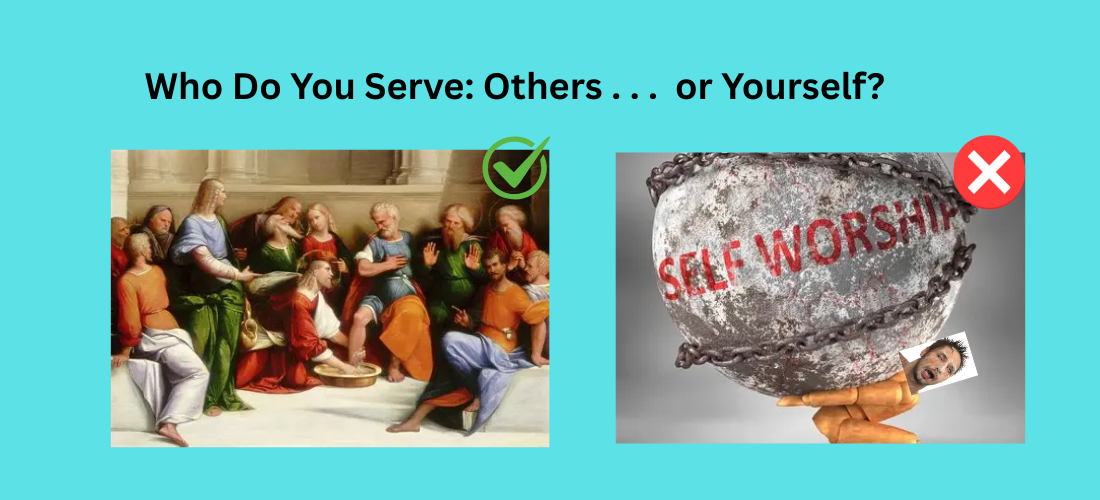
God gave us Two Great Commandments: to love Him and to love our neighbors, though we often resist them in favor of fleeting, selfish, miserable pleasures. While real Catholics sacrifice personal prosperity, self-respect, and honors to serve others, zombies seek to retain them feverishly. The latter category is, I’m afraid to say, the preponderance of humanity these days.
Nevertheless, there is hope! Perhaps it may help to explore some inspiring stories, which show us the tremendous value of observing God’s commandment to love others.
Since it is still the Christmas season (until Candlemas), let’s enjoy a Christmastide meditation on what it means to divorce ourselves from self-centeredness. Let us seek a sacrificial love for others, for otherwise it is impossible to be Catholic, rendering us every bit as shallow, brutish, and deformed as . . . well . . . you guessed it.
Is it a Wonderful Life? Yes, If You Serve Others

It is indeed a wonderful life, provided we count our blessings and make peace with the inevitable trials and chastisements that arise.
It would be miserable, as Seneca informs us, if we had advanced warning of every sorrow we would face. The constant rumination over impending afflictions would be enough to madden anyone. Thankfully, God spares us of such burdensome foreknowledge, even though He did so neither for Himself nor the Blessed Virgin Mary, Our Lady of Sorrows. Therefore, let us be grateful.
Despite that, too many people still fixate on future pitfalls and hardships while ignoring the many blessings and mercies we receive. They also lose sight of life’s true purpose: self-sacrificial love for others. The Christmas classic, It’s a Wonderful Life (1946), demonstrates this tendency quite aptly.
In that film, the protagonist, George Bailey (James Stewart) spends several years of his life oblivious to the “mundane” gifts of family, friends, and an ordinary life. While George doesn’t have any problem living for others, doing so instinctively, the movie’s plot revolves around his failure to understand its redemptive value. He does good deeds, even saves lives, without thought of reward, but still considers his life disappointing.
How could that be?
According to George, until he can enact his master plan of travelling the world and building skyscrapers, his life remains unfulfilled. Notice the emphasis on one man’s plans, and recall how God so often laughs at them.
The narration goes through several scenes, illustrating his worsening despair over the doldrums of boring, old, ordinary life. The climax of his slow descent into misery culminates when his adversary, a stereotypical Jewish banker, Mr. Potter, frames him, precipitating his potential imprisonment for embezzlement.
A crestfallen George almost commits suicide on Christmas Eve, and would have done so were it not for the intercessory prayers of his many friends and family. Their prayers reach heaven right as George is about to end it all, prompting his guardian angel to intervene, showing him what life would look like without him.
- NB: I’ll assume you’ve seen the movie and won’t repeat the entire plot, but if you haven’t, then please consider watching it.
Ironically, it would be the very thing George always took for granted → OTHER PEOPLE ← that would save his life. First, it was their prayers—followed by witnessing the gut-wrenching, heart-breaking horror of what it’d be like if his wife, mother, and friends never knew him—to reinvigorate George’s hope.
Here was a man (albeit a fictional one) who lost the will to live before miraculous intervention depicted his folly to him. The second-to-last scene, featuring the dystopian parallel world, taught George (in dramatic fashion) that God’s Two Great Commandments are the only motive for living. Moreover, they stand diametrically opposed to his puny, insignificant master plans for “self-actualization.”
Speaking of which, do you, my friend, possess any grand designs, and do they distract you from serving others? Would you disavow them if it ever came time to lay down your life for your friends, the greatest act of love, according to Jesus Christ?
How devoted to others are you? Which version of George are you . . . right now?
Miniature Catholic Analysis of It’s a Wonderful Life
Just for fun, since it is a solid film, I’d like to summarize some other positive elements (and a few suspect ones) of It’s a Wonderful Life.
I’ll start by noting that yes, the movie is not a theological masterpiece, especially in light of the whimsical angelology of Clarence Odbody. Obviously, Catholics do not believe angels are deceased humans trying to “earn their wings” while toiling away at the paygrade of Angel Second Class.
For what it’s worth, the original short story behind the film (The Greatest Gift) doesn’t claim George’s intervener was an angel. Either way, I don’t think Frank Capra (the film’s director) intended for the movie version’s angel elements to be anything beyond creative license. Movies had much more leeway for campiness back in the day when people could suspend disbelief on various fantasy elements.
Also, some of the dialogue and dancing between George and Mary are semi-suspect, but not enough to render it unwholesome in my estimation. I say that as someone who scrutinizes awful films that other Catholics praise despite their innumerable blasphemies, excessive violence, and simulated sex scenes.
Even the “dropped robe” incident, which could have become a terrible scene, comes across as charming, given some context. Nobody in their right mind would really think George, the same guy who saved people’s lives, would force his new girlfriend to walk home naked. It’s actually reassuring to know there are men who will not expose the fairer sex to shame and terror for selfish titillation.
What else might we take away from this movie?
Well, it distinguishes between the organic community of Bedford Falls and the counterfactual hellscape George encounters in the world without him (“Pottersville”). Although Bedford Falls is no paradise, it seems much more like an organic, family-driven society contrasted with the way it transforms into the Las-Vegas-esque Pottersville.
This shows how much one man’s charity contributes to our surrounding neighbors. Even minor characters like the bartender, Mike, or the coquettish, Violette, become much more vicious or lascivious in the dystopian world without George.
I’m not alone in my appreciation of this distinction, either. I enjoyed this commentary from Beth, “The Catholic Fasting Coach,” who explains the difference between genuine Catholic communities versus the twisted world, governed by folks like Mr. Potter.
“This Christmas and New Year, I want my ordinary life to become the holiest it has ever been. I want to use my struggles with food and weight for good by offering them in fasting and prayer, to slow down the busyness so I can actually see the people God has placed in my life, to lean into my parish, my family, my friends—real Catholic community, not just solo self-improvement, and to turn away from the voice of Mr. Potter—the voice of greed, self-protection, and fear—and toward the voice of Jesus, who calls me to trust, generosity, and self-gift.”
How many of us, with Mr. Potter as our spiritual role model, “live” our lives trapped by the snares of greed, self-protection, and fear? I don’t think it’s a stretch to say that in 2026 the world has long since deteriorated into Pottersville. The public life of Catholicism is a far cry from the envisioned “springtime in the Church.” Likewise, Western civilization bears no resemblance to Bedford Falls any longer.
Even if most of us wouldn’t jump off a bridge on Christmas Eve out of despair, we still behave like zombies who haven’t left a sufficiently holy legacy around us. Each of us, including yours truly, could stand to do more to ensure the world would indeed be worse off had we not been born.
Also, many of us are not as heroic and gifted as George Bailey, meaning we stand a better chance of receiving an Ebeneezer-Scrooge-style visitation. We wouldn’t get a fantastic vision of how life would be miserable without us. Instead, we’d encounter the Ghost of Christmas Future, exhorting us to amendment, before we experience the fate of Judas Iscariot, who now wishes (in Hell) that he was never born.
The good news is there’s plenty of time to redeem ourselves.
Finally, what about the film’s producer, Frank Capra? Could he have been another edifying conversion story?
Capra was said to have been a “Christmas Catholic” during his youth, only to grow more fervent in adulthood. He would eventually earn a reputation for portraying stories of authentic Catholic justice (which is not leftism, by the way). Several of his films championed the poor everyman over corrupt political kingpins and manipulators.
Capra considered himself “a Catholic in spirit; one who firmly believes that the anti-moral, the intellectual bigots and the mafias of ill-will may destroy religion, but they will never conquer the cross.”
Of course, his conversion to a deeper Catholicism would have been impossible were it not for the proverbial slap in the head he got from a stranger. Capra once lived as a lukewarm Italian-Catholic, devoted to secular filmmaking alone, until being confronted with this stern rebuke:
“The talents you have, Mr. Capra, are not your own, not self-acquired. God gave you those talents; they are His gifts to you, to use for His purpose. And when you don’t use the gifts God blessed you with, you are an offense to God and to humanity.”
How would you like it if one day you discovered you were an offense to God and humanity?
You might notice the parallels between the scolding Capra incurred and Clarence Odbody’s intervention with George Bailey. Both remind us of the outstanding responsibility we have not to waste the precious gifts God allows us to steward during our brief lives.
Talent and resources are not the only things God bestows upon us with such high expectations. All vocations operate this way → priests, monks, nuns, husbands, wives, and singles. Archbishop Fulton Sheen explicated this notion in a clerical context in his book, A Priest is Not his Own.
Most of us have at least a modest understanding of a priest’s sacrificial role. Sheen’s book took the concept much deeper by warning priests to guard against their careerist ambitions, even if it means enduring several years in menial assistant-pastoral roles against their desires.
A priest is certainly not his own, and neither are laymen if they comprehend why God grants us the talents he does. If not, may each of us get some kind of wake-up call, ala George Bailey and Frank Capra.
At any rate, may God repose the soul of Frank Capra. May his conversion have been most genuine, enough to exit this life in God’s friendship following an admirable filmmaking career.
**BONUS MOVIE RECOMMENDATION** → If you enjoyed the moral lessons of It’s a Wonderful Life, and don’t mind watching old black-and-whites, then consider another classic, Mr. Smith Goes to Washington (1939). In it, the Capra-Stewart tandem partnered again for a terrific storytelling masterpiece about the impenetrable corruption in federal politics. I’d say it was about 70 years ahead of its time, detailing the vicious political machines of those days while anticipating the forthcoming dreadful Deep State. Instead of the ruthless “Taylors of the world” in Mr. Smith Goes to Washington, we contend with the Soros/Gates/Shapiros of Clown World. Prepare accordingly . . .

I hope you found these conversion stories uplifting. There are several more found throughout classic narrations like A Christmas Carol or even How the Grinch Stole Christmas. This is to say nothing of the redemptive real-life conversions of those like St. Mary of Egypt, St. Catherine of Genoa, St. Margaret of Cortona, and others.
Next, let’s explore a difficult stumbling block that many of us face in the 21st-century when charity has been almost extinguished from men’s hearts.
Do You Feel Useless With Nobody to Serve?
Christmastide may be wearisome for anyone who assumes they do not live up to their potential with nobody who will accept their services. Multiply this problem several-fold for those who simultaneously experience chronic loneliness.
Just like George Bailey, it is easy for folks to presume the futility of their efforts after contrasting them with the magnificent deeds of nearby others. I suspect I have at least a handful of widows or widowers among the readership who endure this temptation sharply molded by the dangerous snare of comparing oneself to others.
They may ruminate as such, “Oh, I am old, physically depleted, my spouse and children have departed, and all I can do is stumble around and pray sometimes. What good am I in the fight against the evil forces facing the Church?”
I answer this concern in two ways. First, as I’ve mentioned before, there are plenty of practical means to oppose the tyranny of the Anti-Church, even as puny, seemingly powerless lay people.
Second, we have numerous other service avenues as soldiers of the Church Militant. Below are a few indisputable ways to love others with a solid guarantee of results (even if we do not perceive them).
- Pray for the poor souls in Purgatory (no prayer for them is ever a waste)
- Pray specifically for Amelia from Fatima, one of the rare persons we know will be there a while. Would she not be grateful or consider your efforts “useless”?
- Visit other lonely people who believe their lives are meaningless (maybe it’ll snap them out of it)
- Call or visit a lonely military veteran. There are several, and many experience terrible isolation.
- Write book reviews. Maybe a few people will read them.
- If you pity yourself, then read the Book of Job (particularly its final few chapters). It may also help to read the seventh chapter of 2 Maccabees for a fresh perspective on suffering for others.
- Pray for conversions: What would happen if the next person you pray for finally has an epiphany and withdraws from a life of blasphemy or sodomy before heading to confession?
- Never despair when you receive rejection for job opportunities, romantic prospects, or other individuals you would wish to serve. Many will rebuff your offers, promises, and kind gestures. Although this is not overt persecution, we are still blessed and most dear to God when the world rejects and reviles us, provided we remain in His grace. To be sure, the saints rejoiced whenever the world hated them, exiled them, spit on their faces, or issued an array of other torments.
- . . . skip to the conclusion section for one other important suggestion.
Next, we should imagine what it is like whenever people ruin themselves with self-love or even purge all charity from their hearts. What is it really like to be an old crank as opposed to growing older in selfless charity?
Love Others or Become a Nursing-Home Scrooge?
Sometimes, it may be difficult to tell whether fictional villains (like Scrooge and Potter) actually manifest in real life. I contend they do, and there are plenty of places to find them among the jaded elderly. When in doubt of this, visit a nursing home, and you will find both the miserly and magnanimous among America’s seniors.
I recently heard a sermon that confirmed this perception. The priest spoke of his experience taking his young pupils to a long-term-care facility, noticing the joyful suffering of some residents, versus the dogmatic self-centrism of others. Some older residents would bear their crosses and infirmities patiently, and were also happier to receive visitors. Contrariwise, the “me-first” seniors would want little to do with Christmas carolers or anyone else who “invaded” their precious dwelling.
What might it be like for us someday if we find ourselves in an “old folks home”?
Will be miserable and cantankerous, like Ebeneezer Scrooge, or patient, humble, and joyously willing to suffer the painful end-of-life inconveniences? Although nursing homes are seldom the first place anyone desires to finish life, such an unpleasant environment could be an efficacious venue to knock away a few years of Purgatory. It depends on how we approach it, contingent upon our view of redemptive suffering.
Either way, an elderly person has nothing to fear as they step closer to eternity, provided they’ve spent their lives loving others over themselves. They have no cause for regret if they spent their years focused on loving God, withdrawing from creature comforts, and embracing their crosses.
Conclusion – Pray to Mary & Joseph for Selflessness
What better examples do we have than those holy individuals who loved Jesus best and now enjoy the office of assisting all others with the salvation of their souls? Devotion to the Holy Family is the fastest and surest way to disavow selfish behavior. Pray the Rosary every day (all 15 decades), especially Our Lady’s Visitation to St. Elizabeth, meditating on the value of friendship.
Also, if you find yourself tempted to join George Bailey at the bridge, overwhelmed with sorrow, wishing you were never born, then concentrate on Our Lord’s Agony in the Garden. The fictional George suffered his Gethsemane that night, and most of us will have ours, sometimes more than once.
Our best refrain is to unite ourselves with the God-Man, who had the most to lament. Let us join our sorrows to those of Jesus Christ, who would sweat blood, knowing how many would disregard his Holy Sacrifice of boundless love. Our suffering is miniscule next to that of a God forced to watch the better part of humanity choose Hell over His perfect charity.
Pray, suffer, and serve others.
Blessed Epiphany and Christmastide, and Ave Maria!

 Catholics Aren't Zombies!