“Jesus, my God, I adore You, here present in the Blessed Sacrament of the altar, where You wait day and night to be our comfort while we await Your unveiled presence in heaven.” -Excerpted from Act of Adoration
Our love of Jesus and Mary must NEVER be conditional. However, our dealings with the world must indeed be so. This is because almost all our regular affairs have been fastened by a vise into the devil’s cruel talons.
Many of our activities must be conditional and cautious. Such is our lot in life given society’s unwavering descent into “clown world.” This even includes attendance at Holy Mass and Eucharistic Adoration.
It is beyond a doubt a most holy practice to spend time with Jesus Christ, adoring His veiled Eucharistic glory. Alas, we must acknowledge the distinct possibility that not every “Catholic place of worship” confects the Eucharist with the correct formula. As such, Catholics face a difficult decision over whether to visit a “non-traditional parish or chapel,” especially if the consecration happened at a Bugnini Party Novus Ordo Mass.
Although I cannot recommend ever attending a Novus Ordo Mass, the prospect of adoring Our Imprisoned Lord at a Novus Ordo parish is somewhat more nuanced. Since we cannot always be certain of a valid transubstantiation, we must determine whether it is possible, let alone advisable, to do a Holy Hour in such a parish. In this article, I will address this concern by introducing a lesser-known contingency: conditional Eucharistic adoration.
What is Conditional Eucharistic Adoration?
Conditional Eucharistic adoration involves a promise to God that you adore what you believe to be the Holy Eucharist if, and only if, Jesus is truly present.
At first glance, this might come across as doubting the doctrine of transubstantiation. Yet, the conditional method is in reality a safeguard for adoring God at a specific location, whenever proper consecration is probable but uncertain. You can walk into a chapel and begin your Holy Hour by saying something to this effect:
“Oh Lord, I believe You are present in the Most Holy Sacrament. Although I do not know whether Your ministers in this location were valid priests or said Your sacred words correctly, I adore You if You are present in this tabernacle.”
This is a simple and pious act, and an admission that you do not know if such-and-such Novus Ordo parish followed the rubric well enough to confect the Eucharist. In this miserable day and age, following the evil Vatican II council, it is a valid concern for any would-be adorer. Of course, there are a few things to remember regarding this conditional practice.
No Holy Hours at Obvious Heresy Factories
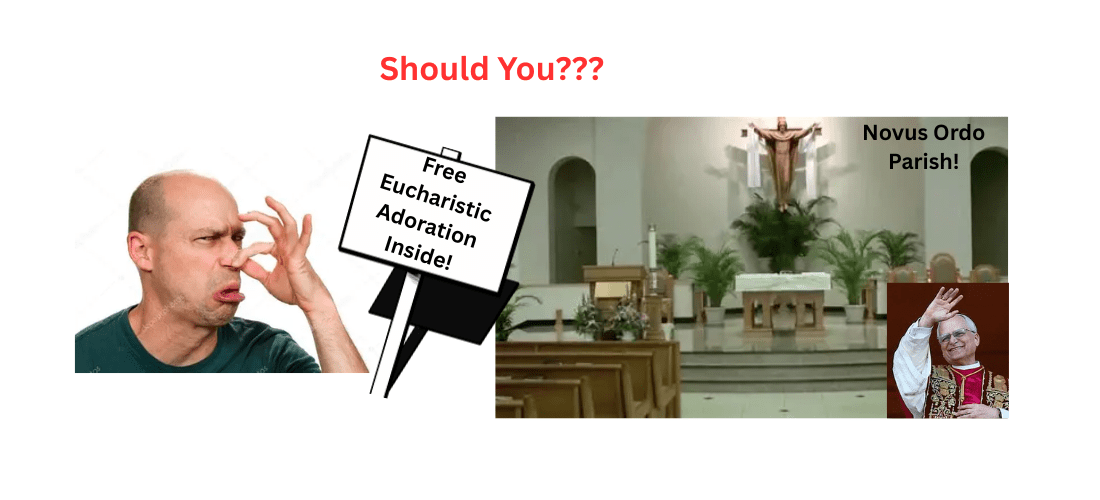
I shall reiterate that nobody should so much as enter a parish that looks like the one in this article’s featured image. You must use discretion to avoid visiting parishes with blatantly anti-Catholic or modernist atmospheres. If you discover a sanctuary without a crucifix, a display of rainbow flags, or some other obvious travesty, then run for the hills.
You also should not attend a Novus Ordo Mass for any reason. In an ideal world, one would follow the advice of Archbishop Marcel Lefebvre and avoid Novus Ordo parishes altogether. I contend, however, there may be an exception if you apply discretion and eschew all other parish liturgies, Bible studies, and activities.
Eucharistic adoration, assuming there is a reasonable possibility of transubstantiation, could still be permissible even at a dreadful Novus Ordo dwelling. This must involve the utmost caution, though.
If you possess a reasonable certainty that the parish clergy confected the Eucharist properly, then there is at least a possibility of adoring Jesus for a Holy Hour. The decision matrix for this requires careful discernment, but there is precedent for conditional adoration, which I will explore next.
St. Teresa of Avila and Conditional Eucharistic Adoration

Some sources say that saints, like St. Teresa of Avila, had to use this practice when met with unreliable clergy.
There came a time when even the holy Carmelite, Teresa, had to question whether the God she adored was truly present at her specific chapel. This was because she suspected her priest harboured Protestant sympathies, including a disbelief in transubstantiation. St. Teresa was no dummy, and not one to fall for Lutheran heretics for long.
What did she do when her convent labored under dubious pastorship?
She did not retreat to a mountain to bemoan a 0% chance of receiving the sacraments (as melancholic panickers do during our times). St. Teresa endured the crisis of a potential Protestant priest by offering conditional adoration of the Blessed Sacrament. I see no reason we cannot do likewise amid similar (or worse) circumstances.
If you follow the last hyperlink, you’ll notice the website editor includes an even shorter prayer for conditional adoration. This is yet another practical way to approach this problem, like St. Teresa:
“My Lord, I adore Thee as long as this host was duly consecrated and Thou art truly present in it.”
This proves a precedent for this method. Therefore, one need not endure scrupulosity over the good intentions to accompany Jesus Christ for a Holy Hour. I would hope this mollifies the anxieties of anyone uncertain of whether to practice adoration in Novus Ordo parishes (unpleasant as they are).
Finally, please remember this situation could change abruptly if the Novus Ordo parishes defect toward something worse than they already are. As soon as Novus Ordo priests align themselves with any forthcoming Beast System or a re-named version of the Catholic Church, then conditional adoration becomes a moot point.
We can say for the time being, albeit on tenuous grounds, that the clergy of some N.O. parishes still intend to be Catholic. This may change in the near future, given the encroachment of the Synodal Church takeover.
Next, prepare yourself to encounter at least some obstacles and distractions if you elect to adore Our Lord in a “decent” Novus Ordo parish.
Common Obstacles to Eucharistic Adoration in Novus Ordo Parishes
- Boomers → they snore, they mouth-breathe, and NEVER turn off cell phones (lest they would die)
- PRO TIP: always remember Munier’s Law → they’re the boomers, and they’re most certainly booming
- Orans Formationists → ignore the difficult distractions involving the 10 to 20% of folks who must pray with the orans formation for at least 25% of their time in the chapel
- Geriatric Social Hour → many of the old ladies WILL use the adoration chapel to “catch up on things” with one another
- People in General → it’s better to target the hours when nobody goes, such as in the evening once the Boomers have gone to sleep (a cessation of their booming)

That’s the gist of conditional Holy Hours. It would, of course, be far better to adore Jesus at a traditional parish where folks behave better, but I recognize most of us lack the proximity to such luxury.
Finally, as we explore the prospects of conditional sacraments, I would be remiss for not mentioning one other controversial subject. The impetus for consternation over invalid sacraments stems from the dubious priests offering them: how they pronounce the sacred words AND regarding how they received Holy Orders.
I could go on for a while about that, but let’s check out a group that once understood the value of “conditional” sacraments, yet does so no longer. Let’s explore our pals from the SSPX.
BONUS PROBLEM: Non-Conditionally Ordained Priests in the SSPX

You may know the SSPX once had a reputation for fastidious vetting of all Novus Ordo expatriate priests (prior to 2012). It even required conditional ordinations for incoming clergy who wished to flee the Novus Ordo paradigm and offer the traditional Mass and sacraments at its chapels.
Nowadays, the Society does not practice such diligence, perhaps as a gesture of “good will” to the apostate hierarchy in Rome (as if Anti-church villains deserved such). This involves a long story of capitulation, but it is one of several reasons we must discern whether to attend Mass even at a traditional chapel. There are, of course, several consequences to the Society’s lapse in scrutiny, as others have explained elsewhere.
These include:
- The potential of invalid priests offering Mass and hearing confessions
- Potentially invalid hosts left in the tabernacle for distribution at subsequent Masses
- A general cause of paranoia, scandal, and scrupulosity among confused laity
With this in mind, we would do well to hear Masses, receive Absolution, or receive Holy Communion only upon certainty of two conditions:
- The SSPX chapel utilizes in-house priests alone (those ordained with the old rites)
- The typical pastor (SSPX-ordained) segregates the hosts consecrated by non-conditionally-ordained priests if ever such a priest had offered Mass there
Absent this certainty, you are better off “backing up and punting,” as they say in football, to await another opportunity to receive the visible signs of God’s grace. This may feel like a sword to one’s gut, but it is a necessary precaution for Catholics who honor Jesus and His holy sacraments.
The alternative is to apply the same conditional approach (as I mentioned for adoration) whenever you hear Mass at a questionable SSPX location. Avoid scrupulosity and intellectual rigidity, offer your willingness to hear Mass conditionally, and make the most prudential judgement possible. When in doubt, it may be best to delay receiving Holy Communion.
God does not challenge us beyond our means, but we will have to account for our liturgical decisions someday.
Conclusion – Unconditional Love for Jesus and Mary
Although it is tragic how we must submit to such hoop jumping just to experience the graces Jesus offers through His sacraments, this has become the cross we must carry. Nothing is convenient any longer, especially if you reside in a hellhole diocese.
That’s another way of saying we should be accustomed to this miserable plight by now. This reality also corresponds with Our Lady’s warnings that we would experience a cruel and extended martyrdom as the world apostatizes logarithmically with each passing year.
Fortunately, Our Loving Mother has assuaged these difficulties by offering other remedies to sustain us during times of doubtful sacraments, treacherous clergy, and top-down hierarchical apostasy. I would suffer no serious offense if you disagreed with my suggestions for conditional adoration, but there is one devotion we must not dismiss during these perilous hours. We must pray the Blessed Mother’s Holy Rosary every day, all 15 decades, with confidence and without hesitancy.
Furthermore, let no one attach any conditions to their love, enslavement, and devotion to Mary. You may get no opportunity to attend Mass or encounter the Holy Eucharist for many months or years. Yet NOTHING will prevent you from following Mary’s loving command to pray Her Holy Rosary, make reparations to Her Immaculate Heart, and always wear the Brown Scapular. Let us attach no conditions to these devotions and only cease them over our dead bodies.

 Catholics Aren't Zombies!