“Praise the Lord, O my soul, in my life I will praise the Lord: I will sing to my God as long as I shall be. Put not your trust in princes. In the children of men, in whom there is no salvation.” –Psalm 145:2-3
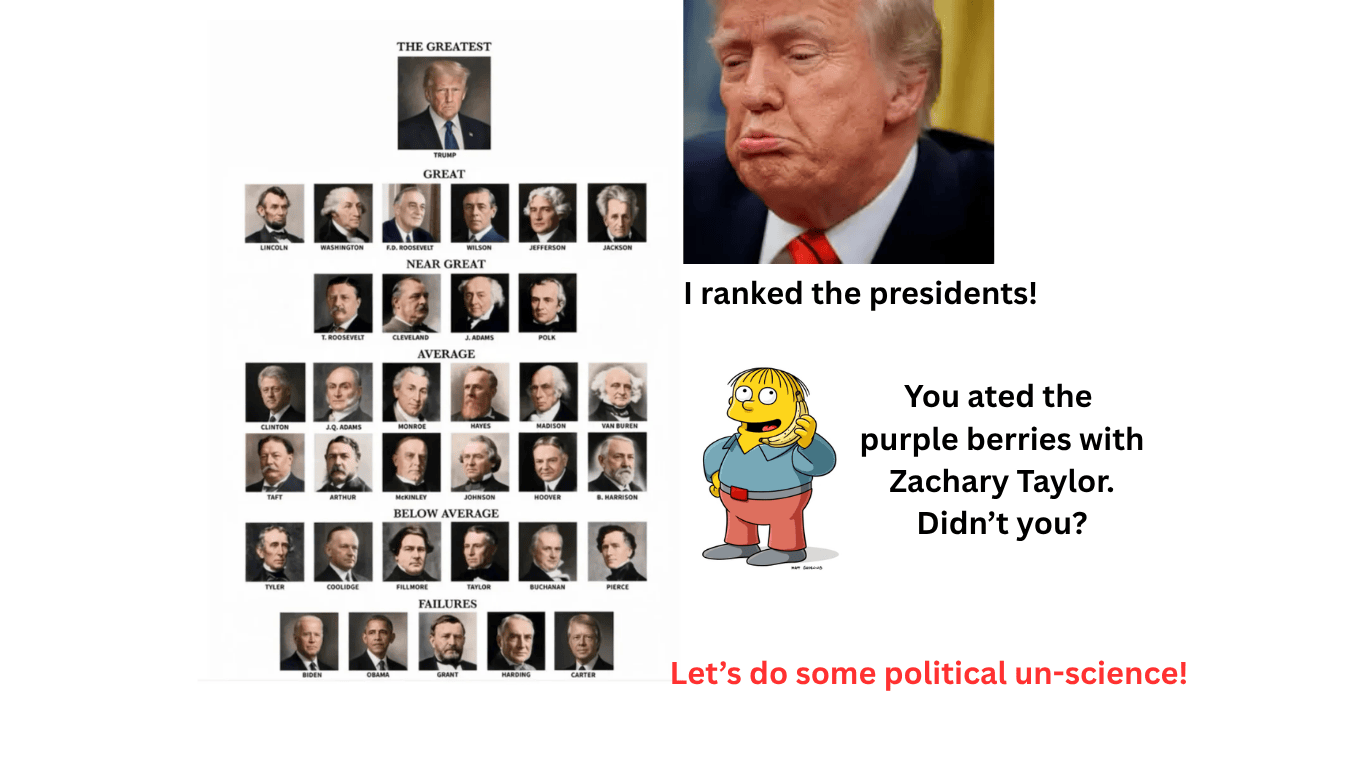
Some of you may have seen, and received a substantial belly laugh from, Donald Trump’s rankings of the United States presidents. The Golden Don decided, to no one’s surprise, that he alone would occupy the apex of presidential greatness. Sober-minded folks would surmise that he has merely positioned himself atop a filthy, stinking used-diaper mountain.
If you cannot see from the featured image, Trump not only considers himself the most magnificent of them all, but insists his next best predecessors were the notorious villains Abraham Lincoln, Franklin D. Roosevelt, and Woodrow Wilson. Trump’s rankings are also absurd and woefully incomplete, as he omits 11 presidents, most of them spanning Harry Truman through George W. Bush.
Then again, if I’m to be honest about it, it looks as if Trump just copied Arthur Schlessinger’s presidential rankings from 1948, swapped a couple of them into different spots, and hopped on top.
Certainly, any of us could have ranked presidents better than Trump, so I’ll attempt the effort myself. While I must style this as “political non-science,” since it is subjective, I have no qualms asserting its superiority to the field’s conventional literature. Most academic political scientists still mumble and drool profusely, exhorting us to honor Lincoln, George Washington, and FDR as the best.
I think a six-year-old from Canada could do a better job if you gave the child a page of presidential portraits and asked him to color them different shades of red or blue for whom they like best. So, given the low bar set by modern academians, perhaps I might have this published in the American Political Science Review (or some other similar rag).
Well, I’ll let you decide.
Re-Ranking the Presidents
I rank these fellows from worst to “best” without using any sophisticated criteria, for such methodology is useless since whoever does the ranking inevitably skews them toward his personal preferences, irrespective of any highfalutin metrics.
Instead, this list goes in descending order of presidents who terrorized the American citizenry and violated the Constitution the most. Presidents with a lower-numbered ranking were (by my judgment) less overtly Freemasonic and tyrannical (though almost all of them were suspected Masons).
45. Abraham Lincoln *WORST* (16th President → 1861 to 1865)
Lincoln capitalized on the country’s north/south fracturing and divided culture to launch a violent war of northern aggression, invigorated by a lopsided tariff war overseas, and suspension of due process while imprisoning his critics. This left what some of us consider a “secular monarchy” in the ruins of the ill-fated American Republic. Yes, Lincoln was the first American king, and like King Saul, communicated with demons through seances while occupying the White House. He and his wife (who eventually went mad) were avid devotees of spirit circles, helping them invite innumerable curses onto the land. Then, for those who still tragically love democracy, it may interest you to know that Lincoln won his first election with less than 40% of the popular vote amid a four-man contest. Even during his re-election, he only defeated the general he once fired with 55% of the vote in an election excluding the South. All in all, nobody liked Lincoln, but he has been psy-oped onto us by the unscrupulous court historians of the 20th and 21st centuries. He was also quite friendly with Jews, refusing to refer to the U.S. as a Christian nation while allowing them to serve as military chaplains.
44. Woodrow Wilson (28th President → 1913 to 1921)
I should hope I do not have to alert Traditional Catholics to the many reasons we ought to loathe the apostle of eugenics, professor, and president, Woodrow Wilson. Even Jews criticize him for eugenic racism (towards blacks) while exclaiming his heroism for eliminating literacy tests, allowing more of them into the country. I could write a much lengthier essay to summarize Wilson’s awful legacy, but I’ll make this brief considering its self-evidence. Wilson’s notoriety includes everything from the creation of the Federal Reserve usury machine and progressive income taxation to sneaking the U.S. into World War I and countless other welfare-state policies over and beyond Teddy Roosevelt’s Square Deal nightmare. He also helped transform the Supreme Court by appointing the first Jewish justice (Louis Brandeis).
43. Donald Trump (45th/47th President →2017 to 2021 & 2025 to Present)
At the top of the website, you can find an entire section titled “Trump Dossier” that offers several reasons to consider Trump’s terms (45 and 47) worse than a miserable failure. We recently discovered even further evidence he’s the first Jewish president with the revelation by his ex-wife that he always carries part of the Zohar with him over his heart. Others, like TradCatKnight, suspect he has affiliations with the Luciferian Golden Dawn cult. At a minimum, he’s a Zionist shill whose popular support has plummeted thanks to horrific economic numbers, the Iran War fiasco, gas price surges, no adjudication of the Epstein clients, and too many other debacles to list succinctly.
42. Franklin Delano Roosevelt (32nd President →1933 to 1945)
FDR is one of Trump’s favorite presidents, a fact I hope convinces more Trump fans to reconsider supporting him. Here’s another arch-narcissist deserving of several volumes of condemnation. Perhaps we’d focus on the most glaring absurdity of all: that the American electorate re-hired this guy for FOUR terms. It’s amazing the level of insanity the populace will endure in the name of maintaining a “consistent wartime president.” Of course, for even the intermediate students of alternative 20th-century history, it would be impossible to overlook FDR’s military leadership as a former Deputy Naval Secretary who would eventually bait the Japanese into attacking Pearl Harbor. Surely, someone with his experience managing naval affairs would know not to park that many boats in Hawaii, not but a stone’s throw away from a belligerent thirsting for an excuse to attack. These things, my friends, do not happen by accident.
41. Lyndon Baines Johnson (36th President →1963 to 1969)
Should Johnson be higher than Barack Obama? I could go either way with either upper-tier tyrant. Obama was more charismatic (enough to dupe stupid millennials), whereas Johnson probably had a role in the Kennedy assassination, to say nothing of his infamous narcissism. It was said that he and his co-conspirators had to be told to quiet down while celebrating Kennedy’s assassination aboard Air Force One for fear that Jackie Kennedy might over-hear their exuberance. Even as Senate Majority Leader, Johnson would intimidate fellow legislators by giving them “the treatment,” which involved the imposing 6’3” Texan leaning into them intensely during discussions. You can see examples of this here and here. Finally, black Americans would not have sustained such an incredible cultural collapse were it not for Johnson’s “Great Society” scourge.
40. Harry Truman (33rd President →1945 to 1953)
Although I acknowledge there is a developing debate over whether nuclear weapons truly exist, we should never forget that, if they are real, then Harry Truman is the sole sovereign leader in the world to have launched them. He did so twice against Japan after his forces unleashed an even more destructive non-nuclear assault on Tokyo. The war had already finished, yet Truman, possibly inspired by the diabolical, had to “crush them Japs” and send a message to the Soviet Union that they could be next. Truman was the Grand Master of a Freemasonic lodge in Missouri while he served in the Senate and left office with a record-low approval rating of 22%. Also, make of it what you will, Truman was the first Medicare recipient in 1965.
39. Barack Obama (44th President →2009 to 2017)
For various reasons, Western Civilization has taken a nosedive since around 2008. I suggest it had more to do with that year’s massive economic collapse, exacerbating the long-term decline of the U.S. dollar. Yet, we can’t ignore how effective Obama and his handlers were at engineering the country into a social/cultural hellscape as well. We might think of the Obama years as the nexus between the slowly deteriorating “old U.S.” into today’s unprecedented “clown world.” To make matters worse, there’s a lengthy proof set suggesting Obama has never been a U.S. citizen and his real name is Barry Soetoro. Finally, owing to his time in Chicago, Barry may have been a protégé of the suspected-Luciferian “cardinal” Joseph Bernardin. I could go on and on with credible conspiracy theories involving this suspicious fellow, who is emblematic of a society which itself has fallen into the talons of so many dangerous murderers, sodomites, usurers, and occultists.
38. Theodore Roosevelt (26th President →1901 to 1909)
Teddy Roosevelt was the godfather of the “executive order,” a loophole trick presidents employ to bypass the lengthy legislative process and expedite their agendas. Presidents used executive orders with tremendous frequency, beginning with Roosevelt and all the way through Harry Truman’s term. Believe it or not, modern presidents are statistically much less apt to issue executive orders than the presidents from 26 through 33 with but two exceptions. Teddy had 1,006 orders, whereas his immediate predecessor issued just 51. Even Joe Biden’s supposedly lofty executive order total didn’t reach a third of Roosevelt’s. Not only was he one of the most staunchly interventionist presidents in history, but Teddy also sabotaged his successor (William Taft) by challenging him to regain the presidency during the election of 1912. This led to a split in the Republican vote, enabling Eugenicist in Chief Wilson to ascend to power (with most unfortunate results).
37. Joe Biden (46th President →2021 to 2025)
Yes, it may be generous putting Biden ANYWHERE on a “president” list, recalling his most dubious (s)election in 2020. It’s no coincidence that his auto-penned presidency and Antipope Jorge Bergoglio’s reign of terror culminated at about the same time. Both men represent the height of the “everything is fake” paradigm of the 21st century. Since I believe Biden’s horrible legacy is so self-evident and remains fresh in our minds, I’ll leave you with the Big Man’s best speech ever for a few chuckles.. RIP Corn Pop.
36. George W. Bush (43rd President →2001 to 2009)
Many observers assume George W. Bush possessed the IQ of an orangutan, as many of his left-wing critics often asserted. However, I contend he is in the same category of political actors as Kamala Harris. Neither Bush nor Harris used to sound as buffoonish as they became upon reaching the national stage. Rather than being genuine dimwits, these two were commissioned to act like ones to suit the purposes of the ZOG and other global villains. You can verify that claim with no trouble by looking at old speeches Bush gave before becoming president (such as this one from 1988). At any event, actor or not, I don’t think any honest commentator can ignore Bush’s Iraq War embarrassment, a stagnant economy that segued into Obama’s socialism, the Patriot Act, and several other hideous federal expansions (i.e., “Homeland Security”). If you have a pretty wife, or are one yourself, then you can thank George W. Bush for every time the perverted TSA agents selected her for the perverse “porno scanners” at the socialized airports after the Patriot Act.
35. George H.W. Bush (41st President →1989 to 1993)
I could make the case that Bush Sr. was much more villainous than his son, especially after remembering the infamous “New World Order” speech he gave back in 1991. Both he and his father, Prescott Bush, were suspected of involvement in the Kennedy assassination and the Watergate scandal. In all honesty, if he had held office for longer than a single term, I’d have to put him higher on this list (worse) as justice for the further offense of getting his son into politics. As we Catholics know, Jesus Christ will hold parents accountable for the iniquities of their children.
34. Millard Fillmore (13th President →1850 to 1853)
Fillmore did not chastise the American public with too many heavy-handed policies, but he earns a poor ranking because of his involvement with the “Know-Nothing Party,” which espoused a platform of vehement anti-Catholicism. It would make no sense for me to put somebody like that into a better position, though I’ll admit his presidency was mostly uneventful after succeeding to the White House upon the death of Zachary Taylor. For what it’s worth, Fillmore also makes Time Magazine’s list of Top 10 Forgettable Presidents. Most of the others on that list I would consider decent chief executives.
33. Bill Clinton (42nd President →1993 to 2001)
There’s a terrific argument for putting this obnoxious fellow in a much worse position, not far from Bush Jr. or Obama, but he shall not receive credit for the works of his wife. If it’s just plain-old Bill himself, then I argue he was far less destructive than essentially ALL of his successors, remarkable as that may seem for the guy responsible for NAFTA. Clinton usually gets credit for presiding over a robust economy, but that’s another thing for which he should not receive credit if we employ just a modest understanding of boom-and-bust cycles, generated by the Jews running the Federal Reserve. Old Bubba got to ride the boom, whereas his bellicose successor had to carry the bust.
32. Richard Nixon (37th President →1969 to 1974)
Everyone remembers Tricky Dick for the Watergate scandal. Some are aware that his obstruction of justice paled in comparison to that of today’s more iniquitous politicians (see the previous entry’s lovely wife, for instance). However, there was much more to the Nixon administration that damaged his legacy. He presided over arguably the worst of the Vietnam embarrassment, the final destruction of the Gold Standard, a crummy economy, all while American culture entered its first death throes by the early 70s. Nixon was also the first president to declare war on drugs, involving substances I oppose myself, but cannot help but notice the interlacing of that hapless war with his predecessor’s agenda. Taken together, Nixon’s drug war and Johnson’s Great Society led the U.S. to become one of the most incarcerated populations ever, driven by an accelerated, socially engineered annihilation of black American culture.
31. Rutherford B. Hayes (19th President →1877 to 1881)
Even the miserable court historians who embellish the heroics of most presidents have been compelled to call Rutherford B. Hayes, “His Fraudulency” because of the shenanigans leading to his election. Hayes won the race by a single electoral vote over Samuel Tilden in the most disputed election until George W. Bush defeated Al Gore in 2000. Each side disputed the votes in three battleground states: Florida, South Carolina, and Louisiana, leading to the same shady vote-counting debacle we enjoy every election cycle nowadays. Then again, I suppose for a 19th-century Republican, Hayes wasn’t the worst, and he “generally” lightened the coercive Reconstruction sanctions on the former Confederate States, primarily because the federal government couldn’t afford the expensive occupation any longer.
30. James K. Polk (11th President → 1845 to 1849)
Where do Donald Trump and other American political conquerors get their inspiration for territorial expansion? Well, look no further than James K. Polk, AKA “Mr. Manifest Destiny.” Polk wasn’t the lone conceiver of the American expansionist ideology, but this assertion that the U.S. must conquer every inch of the North American continent has had some dreadful consequences. This is how massive, uncontrollable empires with no semblance of subsidiarity form and become behemoths. The more territory a single nation-state grabs, the more control an autocrat or group of oligarchs possess over people, land, and resources. We’ve seen the rotten fruits of this even with the acquisition of territories like Alaska, which should be a boon for oil manufacturing. Yet, it is not because the ruling elites have restricted it to justify their domination of overseas oil markets. These same oligarchs pay American farmers not to farm to their fullest capacity so as not to disrupt the elites’ precious agricultural supremacy. I could cite numerous other examples, but I believe the point is clear: territorial expansion serves nobody except the lords of empires.
29. Ulysses S. Grant (18th President →1869 to 1877)
Grant was one of those war generals who did his job well enough but was terrified at the sight of blood. It’s anyone’s guess how endured it, considering the barbarity of the conflict, thanks to an array of novel weaponry designed for blood-and-guts mayhem. The same General Grant would reign for two terms during the vicious Southern Reconstruction, during which his administration was too corrupt for even the court historians to defend. The examples of corruption span everything from manipulative tax collection and bribery of railroad tycoons to crashing the stock market over a scheme that allowed Grant’s relatives to corner the gold market.
28. Jimmy Carter (39th President →1977 to 1981)
Most folks remember Carter as a gentleman peanut farmer who liked to build homes for the poor after his one-term administration ended with a gas crisis and the Iran hostage fiasco. Those of us who study alternative history and journalism know there was much more to his legacy. Carter was a veritable stooge of the Trilateral Commission (a despicable Rockefeller “secret cabal” and tentacle of the Council on Foreign Relations). In other words, Carter was no “outsider” but yet another deep-stated political hack, like every other member of the modern “Uni-party” of at least the past 60 years.
27. William McKinley (25th President →1897 to 1901)
This is the man from whom Donald Trump gets his tariff fixation. You can Google search “U.S. president best known for tariffs” and verify that yourself. He and Trump espouse the same sovereign protectionist philosophy, which always engenders horrible economic consequences and isolationism. McKinley is also the source of a most superfluous controversy regarding the naming of America’s largest Alaskan mountain. He is one of two American presidents (along with James Garfield) to die from assassination during the month of September. That may be a coincidence, but Americans have become accustomed to September and October as the most notorious months for surprises, recalling violent episodes like 9/11/01 or the Charlie Kirk ordeal in 2025. It wouldn’t surprise me if McKinley’s assassination was more of a Freemasonic sacrifice ritual. His demise did, after all, lead to the aforementioned ascension of Teddy Roosevelt, yielding most sorrowful results.
26. Herbert Hoover (31st President →1929 to 1933)
Herbert Hoover gets raked over the coals by modern historians for “not doing enough to remedy the Great Depression.” Everyone believes he did nothing other than watch things burn like an American Nero. This, however, is not true, just as it wasn’t true that George W. Bush ran a “laissez-faire” economy leading into the 2008 stock market crash. Both Hoover and Bush enacted plenty of regulatory interventions, money printing, and bailouts while desperate to save their crashing economies. Then, when those moves failed, voters blamed the “free market” for the economic crashes, leading voters to replace the hapless “conservatives” with aggressive socialists: FDR and Obama. Yes, yet again, Hoover and Bush are obvious examples of the problem→reaction→ solution dynamic.
25. John Adams (2nd President → 1797 to 1801)
If there weren’t so many other far more rotten presidents to have succeeded him, Adams would be closer to the worst end of the list. We ought not to overlook the Alien and Seditions Act (proto-censorship in American politics), whereas all of his “Midnight Appointments” demonstrated the mindset of someone desperately clinging to power. He also put the treacherous, central-bank-loving Alexander Hamilton in charge of the army. I think it’s simple enough to say Adams had a better reputation as a lawyer during the Boston Massacre trials than for his presidency (which he himself lamented).
24. Andrew Johnson (17th President →1865 to 1869)
Most American children go all the way through their education and into adult lives without ever knowing that the plot to assassinate Abraham Lincoln involved several conspirators who targeted multiple administration members. This included Vice President Andrew Johnson, a Democrat who replaced Lincoln’s former Republican VP, supposedly as a “compromise” move to help win re-election and hasten Reconstruction. Johnson, who didn’t do much to help his southern brethren during the torturous post-war period, was also a target for assassination in a plot carried out by John Wilkes Booth and several other men. Lincoln’s Secretary of State, William Seward, narrowly escaped his own demise, whereas Johnson’s intended assassin got too drunk and failed to kill the vice president. Bizarre as that must have been, authentic historical records contradict the facile argument for a “lone gunman” in the Lincoln assassination.
23. Dwight D. Eisenhower (34th President →1953 to 1961)
I don’t take a strong stance on Eisenhower, which is why he’s almost in the center of these rankings. However, I think it’s impossible NOT to contrast his legacy with that of George S. Patton, his subordinate general who died mysteriously and was buried overseas, known for his inability to “play ball” in politics. Some say Patton’s death was a foul-play conspiracy, whereas there’s no disputing Eisenhower’s success as a two-term Republican president, the first time for anyone in his party since Ulysses S. Grant. What did we get for eight years of Ike during the halcyon 1950s? Although he ended the Korean War, he technically started the Vietnam conflict. Ike made a more lasting impression by signing the communist National Interstate Highway and Defense Act, something that the federal government has used countless times to extort all 50 states into compliance. By that, I mean compliance with speed-limit laws or raising the legal age for drinking by threatening to withhold precious “highway funding” from rebellious states. Don’t forget, also, that socialized highways are a means for controlling movement, yet another component of Marxism (see point six from that link).
22. Ronald Reagan (40th President →1981 to 1989)
I don’t exalt Reagan anywhere as much as modern conservatives, of whom I’ve not withheld my many criticisms. The Gipper has received praise for adhering to limited government, yet he proposed an expensive ballistic missile defense system, failed to eliminate Carter’s ridiculous Department of Education, and favored open borders, a veritable lifeblood for welfare state expansion. Furthermore, we cannot even admire Reagan as a moral paragon since he and everyone else in his family got divorced, his daughter appeared in a porn magazine, and his son became an insufferable leftist. The exaggerated accomplishments of the Reagan years, albeit superior to the disastrous Carter regime, were nebulous at best.
21. Gerald Ford (38th President →1974 to 1977)
I could justify putting Ford in a much worse spot on this list because of his role in the wicked Warren Commission (that didn’t investigate the Kennedy assassination). However, if we focus on his presidency alone, it was a ho-hum, caretaker, transition administration by and large. Now, he lives on in our memories as a president who fell down often, pardoned Nixon, and furnished his administration with loathsome figures like Nelson Rockefeller, Donald Rumsfeld, Henry Kissinger, and Dick Cheney.
20. Warren G. Harding (29th President →1921 to 1923)
Conventional history asserts that Harding’s presidential cabinet was perhaps the most corrupt, and I don’t necessarily dispute that (see Teapot Dome Scandal for the gist of it). I have his successor, Calvin Coolidge, in the “best” spot on my list, made possible because Harding died in office. Some say his wife may have poisoned him. Other than that, he was a welcome departure from the previous Wilson regime. Then again, I can’t give Harding too much credit, seeing how he was one of several presidents to sign resolutions calling for the establishment of a Jewish homeland.
19. George Washington (1st President →1789 to 1797)
I could justify putting Washington much higher on this ill-begotten list. Historians debate whether he became a Catholic on his deathbed, but that’s somewhat of a moot point since he didn’t die while in office. I can grant the man the benefit of the doubt for taking a brand new position following a new Constitution. Mistakes and shortcomings were inevitable, and I think almost anyone can appreciate his famous “avoid entangling alliances” farewell address. However, Washington had more than just the standard volume of secret-society baggage. His Freemasonic worshippers turned him into a demi-god by “immortalizing” his likeness in the Capitol Dome with a fresco of Washington ruling on high. I wonder if they used tax dollars to do that in 1865. I also wonder if they pulled that garbage with any other Freemasonic “hero” that year. Don’t forget, by the way, that these are the same gnostic narcissists who believe they too are becoming gods, or will become “one with God.”
18. John Quincy Adams (6th President →1825 to 1829)
J.Q. Adams was a polyglot, a skilled diplomat, and among the presidents with the highest IQs. He, like his father, may have had a better calling to an intellectual/academic career rather than politics. By the time of his presidency, America had finally embraced partisan politics with divisions based on geography, competing industries, and, worst of all, whether to have an American central bank (like the future Federal Reserve). Adams was a proponent of central banking, unlike his rival Jackson, and he also supported high tariffs (like Donald Trump). With all that in mind, it’s hard to consider him anything beyond a mediocre one-term president.
17. Benjamin Harrison (23rd President →1889 to 1893)
Benjamin Harrison occupied the White House between the two non-consecutive presidencies of Grover Cleveland, meaning he ousted him in 1888, only to receive that exact measure of revenge in 1892. I think the tail-end of the 19th-century was a relatively tame era of presidents (until McKinley and Roosevelt arrived), but Harrison was somewhat of a lighter version of McKinley, emphasizing tariffs. For anyone confused on this issue, tariffs, favored by the 19th-century Republicans, were a contentious way for the U.S. Treasury to generate revenue by taxing imports. The problem is that, like every other tax, the bill inevitably passes on to the consumer (within the tariff-imposing country). We should view pro-tariff presidents with the same disdain we have for “tax-and-spend, liberal Democrats” and central-banking shills. All of them wish to bolster the state, use it to make themselves wealthy and powerful, while impoverishing American families. It’s one of the primary reasons democracy and republicanism do not work.
16. James Madison (4th President →1809 to 1817)
Madison was the primary author of the U.S. Constitution, a soft-spoken man, and the shortest president (at 5’4”). He was president during the War of 1812, one of the few non-aggressive conflicts in American history. As such, it would be fair to rank Madison as a decent Commander-in-Chief for surviving it. Though I think credit for that belongs to the Holy Mother of God, which I will mention again in the section on Andrew Jackson.
15. Thomas Jefferson (3rd President →1801 to 1809)
Jefferson’s critics revile him for the wrong reasons (owning slaves) while his admirers overlook his various character flaws: his deism, his penchant for dabbling with the Scriptures without referencing the Church fathers, and we Catholics can’t ignore his fixation with “liberty.” Jefferson, like almost everyone else on this list, had ties to Freemasonry, something an astute observer would notice from the wording of his Declaration of Independence. All in all, I don’t extoll Jefferson, like libertarian-conservatives, but I wouldn’t place him among the more ornery White House occupants.
14. James Monroe (5th President →1817 to 1825)
This section of the rankings features many of the early presidents, including the fifth officeholder, James Monroe. Monroe loses points for selecting Elbridge Gerry (the founding father of Gerrymandering) as his running mate, but aside from that, I don’t think you could call Monroe an awful president. I, however, caution against considering him a “great” president, given what’s become of his Monroe Doctrine (that the U.S. should dominate the Western Hemisphere) now that Donald Trump has morphed it into a monstrosity.
13. James Buchanan (15th President →1857 to 1861)
Political scientists and historians often consider Buchanan one of the five worst presidents, mostly out of love for his tyrannical successor, Lincoln, but also because they view the Civil War as something Buchanan should have prevented. He was a Democrat but not a southerner, having built his career in Lancaster, PA, back when that was the state’s capital (until 1812). Even during his time, his fellow northerners ridiculed him for having just the slightest empathy for Americans in the South. In other words, he was like the white man’s version of an “Uncle Tom,” according to typical obnoxious “abolitionist” Yankees.
12. Andrew Jackson (7th President →1829 to 1837)
Andrew Jackson’s legacy is that of a strong, masculine, and decisive leader who opposed central banking, at least back when people cared about those things. His downside is that he wasn’t Catholic, even though he most certainly should have been, given what he encountered while he was a general during the War of 1812. At the Battle of New Orleans (1814), Jackson had the unenviable task of taking a rag-tag assembly of militiamen from different states, most of them un-armed and un-trained, to halt the advance of the British navy. By all natural accounts, he should have been obliterated or forced to surrender. However, by the intercession of Our Lady of Prompt Succor, answering the prayers of the holy Ursuline nuns, Jackson’s forces pulled off a miraculous upset, as his troops suddenly obtained “deadly accuracy” as riflemen. You should read the full account of the miracle here, but I reference it, largely out of frustration, because Jackson never converted to Catholicism, yet clung to his Protestant beliefs until death. Oh, what could have been . . .
11. James Garfield (20th President →1881)
President Garfield was the only president to have written a proof for the Pythagorean Theorem. I suppose if he knew he would suffer assassination just 5 ½ months into the presidency, he would have quit politics and become a mathematician. Throughout the 237-year history of the presidency, only Wiliam Henry Harrison had a shorter tenure. Garfield’s death could have been one of the few legitimate “lone gunman” operations, but I won’t say that for sure. I will note that Garfield’s killer must have had the most schizophrenic eyes among any suspected assassin. Nonetheless, I grant plenty of credit to Garfield and Harrison for dying before they could harass the nation with horrible policies, but, unlike Harrison, I’m somewhat certain Garfield would have done plenty of damage whilst continuing the “radical Republican” agenda of the late 19th century. He was the successor to His Fraudulency, Rutherford B. Hayes, so there was a decent chance he would have kept the same semi-Reconstruction machine going to some extent or another.
10. Zachary Taylor (12th President →1849 to 1850)
If you didn’t get the joke in the article’s featured image, then I’ll provide the background for it here. Zachary Taylor died after eating suspicious cherries, making him the second president to enter into eternity while still in office. He was also an army general all the way until his election. Since he served for just over a year, Taylor didn’t stir up too much trouble or appoint a bunch of Jews to important posts, but he selected the Anti-Catholic Millard Fillmore as his running mate (who would become president after his death).
9. William Taft (27th President →1909 to 1913)
William Taft, along with Warren G. Harding, was one of only two presidents (between Teddy Roosevelt and Truman) to cease issuing hundreds of executive orders. You could say he had a remarkably restrained administration, given that he did not duplicate the aggressive trust-busting and progressivism of his predecessor, Teddy Roosevelt. Taft also scores a few positive points for opposing Woodrow Wilson’s appointment of the first Jewish Supreme Court Justice, Louis Brandeis, criticizing his “extreme Judaism.” Nevertheless, poor Taft would later become the Court’s Chief Justice and get stuck dealing with all that extreme Judaism for about nine years alongside Brandeis. How excruciating that must have been.
8. Chester A. Arthur (1881 to 1885)
Chester A. Arthur was the Republican who took over after the Garfield assassination, and may have continued the Lincoln/Grant/Hayes Republican nightmare dynasty, but his administration was decidedly unremarkable. I view this as a good thing, and a sign that some presidents could park their egos, or at least in the old days there was enough partisan gridlock to halt them from wrecking the country. Alas, neither of those dispositions exists any longer, not since at least the JFK assassination. Speaking of which . . .
7. John F. Kennedy (35th President →1961 to 1963)
JFK was murdered, almost certainly NOT by Lee Harvey Oswald on the exact same day the Vatican voted to ratify the liturgy-destroying Sacrosanctum Concilium (November 22, 1963). He would become president through the same rotten political party as Wilson, FDR, Truman, and his successor LBJ. However, Kennedy and his brother may have been the last men (of any political significance) to oppose the Federal Reserve, the war machine, and the then embryonic “New World Order.” It’s either that or you have to believe, yet again, the hysterical “lone gunman” theory regarding both men’s killers (or that they secretly lived on a faraway resort laughing at us for thinking they were martyrs). Decide for yourself, dear reader.
6. Martin Van Buren (8th President →1837 to 1841)
Van Buren is a common favorite on presidential rankings constructed by libertarians and other small-government enthusiasts. Ivan Eland, author of Recarving Rushmore, for instance, has Van Buren as the third best president because he addressed the Panic of 1837 without wrecking the economy with “stimulus” and government interference, thereby avoiding a much longer depression. I’m inclined to agree. Believe it or not, whenever a crisis arrives and you assess all available remedies, the option to “do nothing” is always available. Today’s social engineers and micro-managing economists make heresy out of such an assertion, however.
5. Franklin Pierce (14th President →1853 to 1857)
I must admit that among all the presidents that “didn’t do much,” some of them simply lacked the opportunity. We might wonder what could have happened if a Franklin Pierce or a Chester A. Arthur got elected in the 20th/21st centuries. We could also say that 80 to 90% of presidents were puppets the entire time, particularly once you get to George W. Bush and beyond. Once again, I’m inclined to favor the presidents that all experts believe were failures. Moreover, the Civil War, sometimes blamed on negligent Democrats like Pierce and Buchanan, should only be remembered as a War of Northern Aggression, orchestrated by the Radical Republican Party, the party of Lincoln.
4. Grover Cleveland (22nd/24th President →1885 to 1889 & 1893 to 1897)
Grover Cleveland vetoed congressional legislation 584 times, second only to the four-termer, FDR. However, unlike FDR, a fellow Democrat, Cleveland was a dedicated reformer rather than an un-constitutional tyrant. He was a staunch defender of the Gold Standard, whereas FDR confiscated gold and kept the country in an economic depression for untold years. Finally, some traditionalists may find it interesting to know that Cleveland was the only president to marry while in office, doing so at age 49 when his bride was just 21. As an aside, I’ve noticed there’s a sharp division among Traditional Catholics between those who support large age gaps between spouses versus those who believe such practice is tantamount to crypto-pedophilia. I could weigh in on this issue, but it would take too long and stretch far beyond the scope of the article.
3. William Henry Harrison (9th President →1841)
My third favorite president was the embodiment of a “hands-off” administration because he simply didn’t get the chance to place his hands onto it for very long. His first and last initials are the same as they are for White House, yet he reigned there for just 30 days (March 4th through April 4th in 1841). His father was one of the Founding Fathers, and his grandson was Benjamin Harrison (# 17 on this list). The conventional narrative of his death is that he contracted diarrhea and died within a short period. As you might suspect, however, conspiracy theories abound regarding foul play, perhaps orchestrated by the Rothschilds or other “Illuminati” figures.
2. John Tyler (10th President →1841 to 1845)
Tyler was the first Vice President to ascend to the presidency after the death of a sitting president (William Henry Harrison). In those days, nobody anticipated the need to vet the VP before presidential elections, just in case he would assume the presidency. In the first several elections, the presidential and vice-presidential candidates ran on separate tickets, meaning you could have one or the other from a different party (like President Adams and his vice president, Jefferson). So, in rare circumstances, Americans enjoyed a period of peace while a man with no immediate agenda, John Tyler, controlled the executive branch. While he was a bit of an expansionist (with Texas annexation) and had raised tariffs modestly, these were not earth-shattering changes like starting wars, establishing a central bank, or conspiring with the global Jewish money changers to wreck society. His critics widely agree that Tyler’s presidency was among the least successful because, in their view, he did not accomplish anything. That, my friends, is why he was great . . . he didn’t accomplish anything. What a mercy it is for us to have rulers that do not achieve their objectives to the extreme detriment of their subjects. Let us beseech God through the intercession of the Blessed Virgin Mary that modern men will no longer enjoy bountiful spoils working on behalf of the forces of darkness.
1. Calvin Coolidge (30th President →1923 to 1929)
You have to admire a politician who could still shut his mouth periodically. Legend has it that Silent Cal, famous for custody of the tongue, was once approached by a woman who had bet her friend that she could get the quiet president to utter more than two words. That elicited his “cool” response: “You lose.” Coolidge’s administration followed the corruption of the Harding White House with a remarkable record of limited intervention and genuinely small government (at least insofar as it was still possible by the 1920s). I thought of putting John Tyler in the number 1 spot, but I’ve seen other folks do that several times and felt like emphasizing someone else for a change. Coolidge’s hands-off approach to governance (aside from a few too many executive orders) was a rarity among 20th-century politicians, whereas Tyler and other 19th-century presidents held office before the Lincoln revolution transformed the office into an autocracy.
Conclusion: Presidents ARE Zombies (usually)
Loyal readers may recall that one of my favorite passages from Holy Scripture is the one that admonishes us how it is better to trust in God than to trust in princes. This message appears in multiple Psalms (145 and 117, for instance).
I especially appreciate the Latin of the text: Bonum est sperare in Domino, quam sperare in principibus. “Princes” translates phonetically as “preen-cheepy-boos” in Latin. I can’t help but chuckle at the silly-sounding translation, at least after reflecting on the clownish mediocrity and cartoonish evil of modern princes/politicians.
If ever there were preen-cheepy-boos that should keep us on guard, it is the entire catalog of U.S. Presidents. These are those men who’ve inflicted one unlawful chastisement after another onto us: through wars, new deals, square deals, taxes, central banks, specialized “tsars,” regulatory agencies, and beyond. Yes, much of it involves the active support (or neglect) of the Congress and judiciary, but, to quote the odious Harry Truman, “The buck stops here” (that is, with the president).
I recommend you detach from things of this world, including its princes, and unite yourself with the Prince of Peace, Jesus Christ. Moreover, the best way to befriend the Prince is to honor the Queen, His Mother, the Blessed Virgin Mary.
While worldlings search for ways to ingratiate themselves with secular princes, we shall find the surest track to the Prince of Peace, who is also Christ the King, by praying Our Queen’s Holy Rosary, all 15 decades. We should do so every day, with careful attention to those Sorrowful Mysteries commemorating Our Lord reigning from the Cross for our sins and our salvation.
God bless, Ave Maria, and avoid the damn Preen-cheepy-boos.
APPENDIX
If it helps, here’s a ranking list (without any other verbiage) for easy visual reference.
45. Abraham Lincoln (WORST)
44. Woodrow Wilson
43. Donald Trump
42. Franklin D. Roosevelt
41. Lyndon B. Johnson
40. Harry Truman
39. Barack Obama
38. Theodore Roosevelt
37. Joe Biden
36. George W. Bush
35. George H.W Bush
34. Millard Fillmore
33. Bill Clinton
32. Richard Nixon
31. Rutherford B. Hayes
30. James K. Polk
29. Ulysses S. Grant
28. Jimmy Carter
27. William McKinley
26. Herbert Hoover
25. John Adams
24. Andrew Johnson
23. Dwight D. Eisenhower
22. Ronald Reagan
21. Gerald Ford
20. Wargen G. Harding
19. George Washington
18. John Quincy Adams
17. Benjamin Harrison
16. James Madison
15. Thomas Jefferson
14. James Monroe
13. James Buchanan
12. Andrew Jackson
11. James Garfield
10. Zachary Taylor
9. William Taft
8. Chester A. Arthur
7. John F. Kennedy
6. Martin Van Buren
5. Franklin Pierce
4. Grover Cleveland
3. William Henry Harrison
2. John Tyler
1. Calvin Coolidge


